Wednesday, September 2, 2009


Monday, April 6, 2009
Summary Blog of the year
1.Canada's airlines struggle to fill their planes
By Scott Deveau, Post April 6, 2009 8:34 AM
2.Oil falls toward $50 tracking stock market
04.06.09, 01:11 PM EDT
Summary
I found these two news are quite interesting because some how they are connected to each other and related to the book. Crude oil was down US$2.51 to US$50.00 a barrel in USA. At the same time London Brent crude fell $1.81 to $51.65 a barrel as well. oil prices have been falling since June, 2008 by the time the economic recession occurred.
Why was the oil price falling? i think the price of oil on the international markets is determined by a combination of forces. Supply and demand are the major factors that affected the crude oil market.
The second article i found was about Canada's airlines continued to reduce capacity in order to meet demand. The reason i put these two articles together is i want to make a connection between them.
West Jet was unable to keep up with its capacity deployment plans, leading to a 4.7percentage point drop in its load factor.
Air Canada's load factor downed by 2.2 percentage points in March to 80.7% after its system-wide traffic fell 13.5% and outstripped its capacity cuts of 11.1% year over year. Its international routes were falling 15.3% and 15.2% on those routes respectively.
Connections
The connections these two articles have to the book is the delivery expense. Delivery expense is ex termly important for merchandising business which buys goods and sells them at a profit. When a wholesaler or a retailer buys goods and sells to the public, the price of their products or merchandises are all affected by their delivery expense, because it is a cost related to the good purchased and must be include in the calculation of cost of goods sold.
And Cost of goods sold plus your gross profit is your sales. Sales are the total amount of the price of each individual product you sold together. Transportation charges on incoming goods are recorded in Delivery Expense, but if the company has its own trucks, transportation charges may turn into gasoline bills, oil, repairs. Transportation companies, heavy industries and all kind of merchandising business rely heavily on the price of crude oil. Well at the end the price of crude oil is affecting everyone in the world.
Conclusion
The price of crude oil is falling caused by polities, wars and the global economic condition. The oil price had been increasing since the 70's

I think the main reason the oil price is falling is because of the global recession. Less people are willing to spend their money like before recession kinda drags the global economic backward. Even though now is the 21Th century Air transportation is
still very expensive to afford and now there are less people willing to travel to other country by Ari plane because of the recession. West jet and Air Canada had both drop their load factor by a very significant percentage. If the crude oil price is till rising at the rate like one year ago, I think they would go bankrupt by now.
Dropping the oil price kinda help improving the economic condition. Transportation business such as Air Canada, West jet and Merchandising business could lower their deliver expense and to survive from bankruptcy.
Thursday, March 12, 2009
Chapter16 Payroll Accounting
Chapter16 is about Payroll Accounting, so I've found a news base on salary and wages.
(link:http://www.thestar.com/Business/article/600786)
Article
The title of this article is "GM workers accept wage freeze"
General Motors workers in Canada have accepted concessions that will freeze wages and increase the costs of benefits until 2012. The cost-of-living allowance will also be frozen until June 2012. Haven't said that under the extension of the current three-year contract to 2012, production workers who currently earn about $34 an hour would not get any wage increases.
General Motors employs needs big savings in labor costs as part of a restructuring plan in order to be qualify for more than $6 billion in loans from the federal and Ontario governments. The union also estimates the concessions by workers and retirees will reduce GM's costs by more than $400 million over three years. GM also admit that the labor cost savings will allow the company to remain a longer period.
The parent GM Corp in USA says it needs several billion dollars more this month from Washington to keep operating because of a continuing plunge in revenues and auto sales.
Connections
In chapter 16 Salaries are paid to office workers, teachers, supervisors and many civil servants etc. And wages are payments to workers for their labor. Basically salary and wages are the same. one thing makes the difference is the Salary is defined as a fixed sum of money paid to an employee on a regular basis over a period of time (usually one year) but instead of years, Wages are payments on an hourly, daily, or weekly basis, or by the piece. Its very rare to see workers accept this kind of situation. After all Wages and salary are benefits for workers and cost for company.
Conclusion
In conclusion this article indicates the importance of balancing the cost of labor. This article also shows us the dimly future of the global economic. Normally workers wouldnt accept wage freeze as whats happening because that's what they are working for. Yet we dont know whether GM's plan is viable and makes sense to taxpayers. Under this three-year contract to 2012, production workers who currently earn $34 an hour would not get any wage increases and a cost-of-living allowance will also be frozen until June 2012. I've saw a lot of strike about workers and labor union complain about their low wages and salary but none of that like this. Its very special to see workers give up their rights and benefits for the uncertain future. i mean after all there is still a chance GM would shut down or go to bankruptcy before their promise goes ture.
Monday, March 9, 2009


Friday, March 6, 2009
Friday, March 06, 2009 Jobs Contract 14th Straight Month; Unemployment Rate Soars to 8.1%
(Link :http://www.bls.gov/news.release/pdf/empsit.pdf)
This morning, the Bureau of Labor Statistics (BLS) released the February Employment Report showing that the empolyment situation is getting worse. Payroll employment has declined by almost 2.6 million in the past 4 months.
2008-10-01 136352 (million)
2008-11-01 135755
2008-12-01 135074
2009-01-01 134419
2009-02-01 133768


By looking at this two graphes we can see comparing to last two years the Nonfarm payroll employment has droped almost 20% and The number of unemployed persons increased by 851,000 to 12.5 million in February which is almost 8.1 percent.
"The unemployment rate continued to trend upward in February for adult men (8.1 percent), adult
women (6.7 percent), whites (7.3 percent), blacks (13.4 percent), and Hispanics (10.9 percent).The
jobless rate for teenagers was little changed at 21.6 percent. The unemployment rate for Asians was 6.9
percent in February, not seasonally adjusted."
connection
The connection this article can link to chapter 15 is the use of trend analysis. Trend analysis is a very useful technique for examining financial statement and analysis presents financial data for a number of consecutive. Although trend analysis is often used to predict future events, it can be used to estimate uncertain events in the past too. but people usually used primarily to see the company or economic flow is performing over the past few months or years. For example, In this article it uses trend analysis to present the current employment situation which is deeply affected by the economic crisis.
Conlusion
Basically Chapter 15 is all about analyzing financial statement. Trend analysis is a comparison between the past time period and the present time period. By collecting information and attempting to spot a pattern, or trend, trend analysis gives us a visual prediction of the future and a visual estimate of the past. As you can see the first picture above, the the unemployment rate rose from 7.6 to 8.1 percent. this is a very significant change. The dramatic change in Nonfarm payroll employment and Unemployment rate represents the current global economic condition. and by looking at the graph, we can predict the Unemployment rate will continue to raise in the next two quarters or three. It may probably pass 10% of the whole population.
Total Nonfarm Payrolls: All Employees
(Link : http://research.stlouisfed.org/fred2/data/PAYEMS.txt)
Report.Title: Total Nonfarm Payrolls: All Employees
Series ID: PAYEMS
Source: U.S. Department of Labor: Bureau of Labor Statistics
Release: The Employment Situation
Seasonal Adjustment: Seasonally Adjusted
Frequency: Monthly
Units: Thousands
Date Range: 1939-01-01 to 2009-02-01
Last Updated: 2009-03-06 10:01 AM CST
Notes: Handbook of Methods Establishment Survey -
(http://stats.bls.gov:80/opub/hom/homch2_itc.htm)
Frequently Asked Questions - (http://stats.bls.gov:80/cps/cps_faq.htm)
DATE VALUE
1939-01-01 29923
1939-02-01 30100
1939-03-01 30280
1939-04-01 30094
1939-05-01 30300
1939-06-01 30502
1939-07-01 30419
1939-08-01 30662
1939-09-01 31032
1939-10-01 31408
1939-11-01 31469
1939-12-01 31539
1940-01-01 31603
1940-02-01 31715
1940-03-01 31826
1940-04-01 31699
1940-05-01 31880
1940-06-01 31978
1940-07-01 31942
1940-08-01 32352
1940-09-01 32810
1940-10-01 33265
1940-11-01 33668
1940-12-01 34172
1941-01-01 34480
1941-02-01 34844
1941-03-01 35094
1941-04-01 35468
1941-05-01 36182
1941-06-01 36651
1941-07-01 37137
1941-08-01 37544
1941-09-01 37836
1941-10-01 37948
1941-11-01 38024
1941-12-01 38104
1942-01-01 38348
1942-02-01 38513
1942-03-01 38936
1942-04-01 39351
1942-05-01 39772
1942-06-01 40028
1942-07-01 40470
1942-08-01 40988
1942-09-01 41254
1942-10-01 41514
1942-11-01 41673
1942-12-01 41915
1943-01-01 42174
1943-02-01 42395
1943-03-01 42553
1943-04-01 42646
1943-05-01 42596
1943-06-01 42781
1943-07-01 42701
1943-08-01 42546
1943-09-01 42484
1943-10-01 42675
1943-11-01 42819
1943-12-01 42747
1944-01-01 42661
1944-02-01 42543
1944-03-01 42291
1944-04-01 42062
1944-05-01 41985
1944-06-01 41947
1944-07-01 41904
1944-08-01 41848
1944-09-01 41671
1944-10-01 41708
1944-11-01 41711
1944-12-01 41861
1945-01-01 41903
1945-02-01 41903
1945-03-01 41795
1945-04-01 41443
1945-05-01 41304
1945-06-01 41148
1945-07-01 40873
1945-08-01 40466
1945-09-01 38500
1945-10-01 38598
1945-11-01 38996
1945-12-01 39111
1946-01-01 39839
1946-02-01 39250
1946-03-01 40192
1946-04-01 40908
1946-05-01 41348
1946-06-01 41732
1946-07-01 42153
1946-08-01 42642
1946-09-01 42908
1946-10-01 43094
1946-11-01 43396
1946-12-01 43379
1947-01-01 43545
1947-02-01 43563
1947-03-01 43605
1947-04-01 43491
1947-05-01 43637
1947-06-01 43808
1947-07-01 43742
1947-08-01 43958
1947-09-01 44201
1947-10-01 44415
1947-11-01 44486
1947-12-01 44578
1948-01-01 44686
1948-02-01 44537
1948-03-01 44680
1948-04-01 44369
1948-05-01 44795
1948-06-01 45032
1948-07-01 45160
1948-08-01 45175
1948-09-01 45294
1948-10-01 45250
1948-11-01 45194
1948-12-01 45028
1949-01-01 44675
1949-02-01 44500
1949-03-01 44238
1949-04-01 44230
1949-05-01 43982
1949-06-01 43739
1949-07-01 43530
1949-08-01 43621
1949-09-01 43784
1949-10-01 42950
1949-11-01 43244
1949-12-01 43516
1950-01-01 43530
1950-02-01 43298
1950-03-01 43952
1950-04-01 44376
1950-05-01 44717
1950-06-01 45084
1950-07-01 45453
1950-08-01 46187
1950-09-01 46442
1950-10-01 46712
1950-11-01 46778
1950-12-01 46855
1951-01-01 47289
1951-02-01 47577
1951-03-01 47871
1951-04-01 47856
1951-05-01 47952
1951-06-01 48067
1951-07-01 48061
1951-08-01 48008
1951-09-01 47955
1951-10-01 48009
1951-11-01 48149
1951-12-01 48308
1952-01-01 48299
1952-02-01 48522
1952-03-01 48504
1952-04-01 48616
1952-05-01 48645
1952-06-01 48286
1952-07-01 48144
1952-08-01 48922
1952-09-01 49319
1952-10-01 49598
1952-11-01 49816
1952-12-01 50164
1953-01-01 50145
1953-02-01 50339
1953-03-01 50474
1953-04-01 50432
1953-05-01 50491
1953-06-01 50522
1953-07-01 50536
1953-08-01 50487
1953-09-01 50365
1953-10-01 50242
1953-11-01 49906
1953-12-01 49702
1954-01-01 49467
1954-02-01 49381
1954-03-01 49158
1954-04-01 49177
1954-05-01 48965
1954-06-01 48896
1954-07-01 48834
1954-08-01 48825
1954-09-01 48881
1954-10-01 48944
1954-11-01 49179
1954-12-01 49331
1955-01-01 49497
1955-02-01 49644
1955-03-01 49963
1955-04-01 50246
1955-05-01 50512
1955-06-01 50790
1955-07-01 50985
1955-08-01 51112
1955-09-01 51262
1955-10-01 51431
1955-11-01 51592
1955-12-01 51805
1956-01-01 51975
1956-02-01 52167
1956-03-01 52295
1956-04-01 52375
1956-05-01 52506
1956-06-01 52583
1956-07-01 51954
1956-08-01 52632
1956-09-01 52600
1956-10-01 52781
1956-11-01 52822
1956-12-01 52930
1957-01-01 52888
1957-02-01 53098
1957-03-01 53156
1957-04-01 53238
1957-05-01 53149
1957-06-01 53066
1957-07-01 53122
1957-08-01 53128
1957-09-01 52932
1957-10-01 52765
1957-11-01 52557
1957-12-01 52385
1958-01-01 52077
1958-02-01 51576
1958-03-01 51300
1958-04-01 51026
1958-05-01 50913
1958-06-01 50912
1958-07-01 51037
1958-08-01 51233
1958-09-01 51506
1958-10-01 51485
1958-11-01 51943
1958-12-01 52088
1959-01-01 52481
1959-02-01 52687
1959-03-01 53016
1959-04-01 53320
1959-05-01 53549
1959-06-01 53678
1959-07-01 53803
1959-08-01 53337
1959-09-01 53428
1959-10-01 53359
1959-11-01 53635
1959-12-01 54175
1960-01-01 54274
1960-02-01 54513
1960-03-01 54458
1960-04-01 54812
1960-05-01 54472
1960-06-01 54347
1960-07-01 54303
1960-08-01 54272
1960-09-01 54228
1960-10-01 54144
1960-11-01 53962
1960-12-01 53743
1961-01-01 53683
1961-02-01 53556
1961-03-01 53662
1961-04-01 53626
1961-05-01 53783
1961-06-01 53977
1961-07-01 54124
1961-08-01 54299
1961-09-01 54387
1961-10-01 54521
1961-11-01 54743
1961-12-01 54871
1962-01-01 54891
1962-02-01 55187
1962-03-01 55276
1962-04-01 55601
1962-05-01 55626
1962-06-01 55644
1962-07-01 55746
1962-08-01 55838
1962-09-01 55977
1962-10-01 56041
1962-11-01 56055
1962-12-01 56027
1963-01-01 56116
1963-02-01 56231
1963-03-01 56322
1963-04-01 56580
1963-05-01 56616
1963-06-01 56658
1963-07-01 56795
1963-08-01 56910
1963-09-01 57078
1963-10-01 57284
1963-11-01 57255
1963-12-01 57360
1964-01-01 57487
1964-02-01 57752
1964-03-01 57898
1964-04-01 57923
1964-05-01 58089
1964-06-01 58221
1964-07-01 58412
1964-08-01 58620
1964-09-01 58903
1964-10-01 58794
1964-11-01 59217
1964-12-01 59420
1965-01-01 59583
1965-02-01 59800
1965-03-01 60003
1965-04-01 60258
1965-05-01 60492
1965-06-01 60690
1965-07-01 60963
1965-08-01 61228
1965-09-01 61490
1965-10-01 61718
1965-11-01 61997
1965-12-01 62321
1966-01-01 62528
1966-02-01 62796
1966-03-01 63191
1966-04-01 63436
1966-05-01 63711
1966-06-01 64110
1966-07-01 64301
1966-08-01 64507
1966-09-01 64645
1966-10-01 64854
1966-11-01 65019
1966-12-01 65199
1967-01-01 65407
1967-02-01 65427
1967-03-01 65530
1967-04-01 65467
1967-05-01 65618
1967-06-01 65750
1967-07-01 65887
1967-08-01 66142
1967-09-01 66163
1967-10-01 66225
1967-11-01 66703
1967-12-01 66900
1968-01-01 66805
1968-02-01 67214
1968-03-01 67296
1968-04-01 67555
1968-05-01 67652
1968-06-01 67904
1968-07-01 68126
1968-08-01 68328
1968-09-01 68487
1968-10-01 68720
1968-11-01 68985
1968-12-01 69245
1969-01-01 69438
1969-02-01 69698
1969-03-01 69906
1969-04-01 70072
1969-05-01 70328
1969-06-01 70636
1969-07-01 70730
1969-08-01 71005
1969-09-01 70918
1969-10-01 71119
1969-11-01 71088
1969-12-01 71240
1970-01-01 71176
1970-02-01 71302
1970-03-01 71453
1970-04-01 71348
1970-05-01 71122
1970-06-01 71028
1970-07-01 71055
1970-08-01 70932
1970-09-01 70949
1970-10-01 70519
1970-11-01 70409
1970-12-01 70790
1971-01-01 70866
1971-02-01 70805
1971-03-01 70859
1971-04-01 71037
1971-05-01 71247
1971-06-01 71253
1971-07-01 71316
1971-08-01 71368
1971-09-01 71620
1971-10-01 71642
1971-11-01 71844
1971-12-01 72108
1972-01-01 72445
1972-02-01 72652
1972-03-01 72945
1972-04-01 73163
1972-05-01 73467
1972-06-01 73760
1972-07-01 73709
1972-08-01 74137
1972-09-01 74268
1972-10-01 74672
1972-11-01 74965
1972-12-01 75270
1973-01-01 75620
1973-02-01 76017
1973-03-01 76286
1973-04-01 76456
1973-05-01 76646
1973-06-01 76886
1973-07-01 76911
1973-08-01 77166
1973-09-01 77281
1973-10-01 77605
1973-11-01 77909
1973-12-01 78035
1974-01-01 78104
1974-02-01 78253
1974-03-01 78295
1974-04-01 78384
1974-05-01 78547
1974-06-01 78602
1974-07-01 78634
1974-08-01 78619
1974-09-01 78614
1974-10-01 78627
1974-11-01 78259
1974-12-01 77657
1975-01-01 77297
1975-02-01 76919
1975-03-01 76649
1975-04-01 76463
1975-05-01 76623
1975-06-01 76519
1975-07-01 76768
1975-08-01 77154
1975-09-01 77232
1975-10-01 77535
1975-11-01 77679
1975-12-01 78017
1976-01-01 78506
1976-02-01 78817
1976-03-01 79049
1976-04-01 79293
1976-05-01 79311
1976-06-01 79376
1976-07-01 79546
1976-08-01 79704
1976-09-01 79892
1976-10-01 79905
1976-11-01 80237
1976-12-01 80448
1977-01-01 80692
1977-02-01 80987
1977-03-01 81391
1977-04-01 81730
1977-05-01 82089
1977-06-01 82488
1977-07-01 82836
1977-08-01 83074
1977-09-01 83532
1977-10-01 83794
1977-11-01 84173
1977-12-01 84408
1978-01-01 84595
1978-02-01 84948
1978-03-01 85461
1978-04-01 86163
1978-05-01 86509
1978-06-01 86951
1978-07-01 87205
1978-08-01 87481
1978-09-01 87618
1978-10-01 87954
1978-11-01 88391
1978-12-01 88674
1979-01-01 88811
1979-02-01 89054
1979-03-01 89480
1979-04-01 89418
1979-05-01 89790
1979-06-01 90108
1979-07-01 90214
1979-08-01 90296
1979-09-01 90323
1979-10-01 90480
1979-11-01 90574
1979-12-01 90669
1980-01-01 90800
1980-02-01 90879
1980-03-01 90991
1980-04-01 90846
1980-05-01 90415
1980-06-01 90095
1980-07-01 89832
1980-08-01 90092
1980-09-01 90205
1980-10-01 90485
1980-11-01 90741
1980-12-01 90936
1981-01-01 91031
1981-02-01 91098
1981-03-01 91202
1981-04-01 91276
1981-05-01 91286
1981-06-01 91482
1981-07-01 91594
1981-08-01 91558
1981-09-01 91471
1981-10-01 91371
1981-11-01 91162
1981-12-01 90884
1982-01-01 90557
1982-02-01 90551
1982-03-01 90422
1982-04-01 90141
1982-05-01 90096
1982-06-01 89853
1982-07-01 89510
1982-08-01 89352
1982-09-01 89171
1982-10-01 88894
1982-11-01 88770
1982-12-01 88756
1983-01-01 88981
1983-02-01 88903
1983-03-01 89076
1983-04-01 89352
1983-05-01 89629
1983-06-01 90007
1983-07-01 90425
1983-08-01 90117
1983-09-01 91231
1983-10-01 91502
1983-11-01 91854
1983-12-01 92210
1984-01-01 92657
1984-02-01 93136
1984-03-01 93411
1984-04-01 93774
1984-05-01 94082
1984-06-01 94461
1984-07-01 94773
1984-08-01 95014
1984-09-01 95325
1984-10-01 95611
1984-11-01 95960
1984-12-01 96087
1985-01-01 96353
1985-02-01 96477
1985-03-01 96823
1985-04-01 97018
1985-05-01 97292
1985-06-01 97437
1985-07-01 97626
1985-08-01 97819
1985-09-01 98023
1985-10-01 98210
1985-11-01 98419
1985-12-01 98587
1986-01-01 98710
1986-02-01 98817
1986-03-01 98910
1986-04-01 99098
1986-05-01 99223
1986-06-01 99130
1986-07-01 99448
1986-08-01 99561
1986-09-01 99907
1986-10-01 100094
1986-11-01 100280
1986-12-01 100484
1987-01-01 100655
1987-02-01 100887
1987-03-01 101136
1987-04-01 101474
1987-05-01 101701
1987-06-01 101872
1987-07-01 102218
1987-08-01 102388
1987-09-01 102617
1987-10-01 103109
1987-11-01 103340
1987-12-01 103634
1988-01-01 103728
1988-02-01 104180
1988-03-01 104456
1988-04-01 104701
1988-05-01 104928
1988-06-01 105291
1988-07-01 105514
1988-08-01 105635
1988-09-01 105975
1988-10-01 106243
1988-11-01 106582
1988-12-01 106871
1989-01-01 107133
1989-02-01 107391
1989-03-01 107583
1989-04-01 107756
1989-05-01 107874
1989-06-01 107991
1989-07-01 108030
1989-08-01 108077
1989-09-01 108326
1989-10-01 108437
1989-11-01 108714
1989-12-01 108809
1990-01-01 109151
1990-02-01 109396
1990-03-01 109611
1990-04-01 109651
1990-05-01 109800
1990-06-01 109817
1990-07-01 109775
1990-08-01 109567
1990-09-01 109485
1990-10-01 109324
1990-11-01 109180
1990-12-01 109120
1991-01-01 109001
1991-02-01 108695
1991-03-01 108535
1991-04-01 108324
1991-05-01 108196
1991-06-01 108283
1991-07-01 108236
1991-08-01 108251
1991-09-01 108286
1991-10-01 108298
1991-11-01 108240
1991-12-01 108263
1992-01-01 108312
1992-02-01 108246
1992-03-01 108296
1992-04-01 108454
1992-05-01 108580
1992-06-01 108640
1992-07-01 108711
1992-08-01 108852
1992-09-01 108887
1992-10-01 109064
1992-11-01 109204
1992-12-01 109415
1993-01-01 109725
1993-02-01 109967
1993-03-01 109916
1993-04-01 110225
1993-05-01 110490
1993-06-01 110663
1993-07-01 110958
1993-08-01 111119
1993-09-01 111360
1993-10-01 111637
1993-11-01 111898
1993-12-01 112206
1994-01-01 112474
1994-02-01 112675
1994-03-01 113137
1994-04-01 113490
1994-05-01 113821
1994-06-01 114136
1994-07-01 114499
1994-08-01 114799
1994-09-01 115153
1994-10-01 115360
1994-11-01 115783
1994-12-01 116057
1995-01-01 116378
1995-02-01 116587
1995-03-01 116809
1995-04-01 116971
1995-05-01 116955
1995-06-01 117186
1995-07-01 117265
1995-08-01 117536
1995-09-01 117781
1995-10-01 117928
1995-11-01 118076
1995-12-01 118207
1996-01-01 118188
1996-02-01 118622
1996-03-01 118885
1996-04-01 119046
1996-05-01 119369
1996-06-01 119647
1996-07-01 119879
1996-08-01 120075
1996-09-01 120295
1996-10-01 120538
1996-11-01 120834
1996-12-01 121001
1997-01-01 121231
1997-02-01 121532
1997-03-01 121844
1997-04-01 122135
1997-05-01 122391
1997-06-01 122644
1997-07-01 122927
1997-08-01 122909
1997-09-01 123417
1997-10-01 123756
1997-11-01 124059
1997-12-01 124358
1998-01-01 124628
1998-02-01 124817
1998-03-01 124961
1998-04-01 125238
1998-05-01 125639
1998-06-01 125851
1998-07-01 125970
1998-08-01 126322
1998-09-01 126540
1998-10-01 126733
1998-11-01 127017
1998-12-01 127359
1999-01-01 127480
1999-02-01 127890
1999-03-01 127996
1999-04-01 128372
1999-05-01 128585
1999-06-01 128851
1999-07-01 129142
1999-08-01 129334
1999-09-01 129536
1999-10-01 129944
1999-11-01 130238
1999-12-01 130532
2000-01-01 130781
2000-02-01 130902
2000-03-01 131374
2000-04-01 131660
2000-05-01 131885
2000-06-01 131839
2000-07-01 132002
2000-08-01 132005
2000-09-01 132127
2000-10-01 132116
2000-11-01 132347
2000-12-01 132485
2001-01-01 132469
2001-02-01 132530
2001-03-01 132500
2001-04-01 132219
2001-05-01 132175
2001-06-01 132047
2001-07-01 131922
2001-08-01 131762
2001-09-01 131518
2001-10-01 131193
2001-11-01 130901
2001-12-01 130723
2002-01-01 130591
2002-02-01 130444
2002-03-01 130420
2002-04-01 130335
2002-05-01 130328
2002-06-01 130373
2002-07-01 130276
2002-08-01 130260
2002-09-01 130205
2002-10-01 130331
2002-11-01 130339
2002-12-01 130183
2003-01-01 130266
2003-02-01 130108
2003-03-01 129896
2003-04-01 129847
2003-05-01 129841
2003-06-01 129839
2003-07-01 129864
2003-08-01 129822
2003-09-01 129925
2003-10-01 130128
2003-11-01 130146
2003-12-01 130270
2004-01-01 130420
2004-02-01 130463
2004-03-01 130801
2004-04-01 131051
2004-05-01 131361
2004-06-01 131442
2004-07-01 131489
2004-08-01 131610
2004-09-01 131770
2004-10-01 132121
2004-11-01 132185
2004-12-01 132317
2005-01-01 132499
2005-02-01 132720
2005-03-01 132841
2005-04-01 133153
2005-05-01 133365
2005-06-01 133624
2005-07-01 133946
2005-08-01 134136
2005-09-01 134223
2005-10-01 134321
2005-11-01 134701
2005-12-01 134861
2006-01-01 135155
2006-02-01 135429
2006-03-01 135711
2006-04-01 135862
2006-05-01 135886
2006-06-01 135956
2006-07-01 136142
2006-08-01 136291
2006-09-01 136438
2006-10-01 136520
2006-11-01 136781
2006-12-01 137000
2007-01-01 137180
2007-02-01 137216
2007-03-01 137400
2007-04-01 137435
2007-05-01 137591
2007-06-01 137645
2007-07-01 137580
2007-08-01 137552
2007-09-01 137652
2007-10-01 137817
2007-11-01 138032
2007-12-01 138152
2008-01-01 138080
2008-02-01 137936
2008-03-01 137814
2008-04-01 137654
2008-05-01 137517
2008-06-01 137356
2008-07-01 137228
2008-08-01 137053
2008-09-01 136732
2008-10-01 136352
2008-11-01 135755
2008-12-01 135074
2009-01-01 134419
2009-02-01 133768
Tuesday, February 3, 2009


Thursday, December 11, 2008
Bank of Canada cuts rates to 50-year low
Source From(http://ca.news.yahoo.com/s/reuters/081209/business/cbusiness_us_economy_bankofcanada_8)
The bank of Canada has cut its key interest rate by three-quarters of a percentage point to a fifty-year low of one point five percent on Tuesday. it also declared the Canadian economy to be in recession. Since December 2007, the bank of Canada has lowered its interest rate by three full percentage points. "The bank will continue to monitor carefully economic and financial developments in judging to what extent further monetary stimulus will be required," it said. so it is possible for the global recession to become worse. Before the bank cut its interest rates, eleven of Canada's twelve primary securities dealers had predicted the bank would cut rates by a half-point and only one had forecast a three-quarters point cut.
In this chapter, it introduced some major functions and services of a bank. one of them is the bank interest. the connection between this article and this chapter is bank. Bank undertake your money's security and also provides their customers' many convenient way to their daily transactions. For example cheques and credit card can help people get rid of cash. As all of you know bring a bunch of cash to shop is not a smart idea. People can also borrow money from the bank temporary and that's how APR existed. The terms annual percentage rate (APR), nominal APR, and effective APR (EAR) describe the interest rate for a whole year (annualized), rather than just a monthly fee/rate, as applied on a loan, mortgage, credit card, etc. It is a finance charge expressed as an annual rate.
I think consumer lending rates are not going to drop much further. In fact, if the bankruptcy rate goes up, so will they. After all profits is one of the most important thing for a company. Banks have many ways to earn their profits. They invest other people's money--the money that is deposited to earn their profits and get money from fees (ATM fees, overdrawn accounts, etc. They also receive interest on the money they lend which is the APR. The rat of APR is always relate and depends on the global economic condition. By lower Nominal APR and the Annual APR, many banks are able to encourage more people to use credid card or to lend money from banks. Also every time transaction occur on credit card or Visa, the bank will charge certain amount of fees.
Friday, November 7, 2008


Sunday, November 2, 2008


Crusader

The Crusades were a series of religion driven military campaigns waged by much of Christian Europe against external and internal opponents. Crusades were fought mainly against Muslims, though campaigns were also directed against pagan Slavs, Jews, Russian and Greek Orthodox Christians, Mongols, Cathars, Hussites, Waldensians, Old Prussians and political enemies of the popes.[1] Crusaders took vows and were granted an indulgence for past sins.
From Wikipedia, the free encyclopedia
Took me a week to finish this.
Friday, October 31, 2008
Chapter12
Source from http://ca.news.yahoo.com/s/afp/081010/oddities/latvia_animals_zoo_offbeat
A zoo in Latvia's capital Riga is providing discounts to a person who’s first or last names are derived from the names of animals or any of natures furry, feathered or scaled creatures. Among Latvians and Russians it is very common for people to have a first or last name that’s derived from an animal. “Dating to the roots of pagan and animistic nature worship, Latvians often have names drawn from nature and animals.”(From RIGA (AFP)) Many famous Latvians such as Artus Irbe (meaning partridge) from legendary hockey goalie and Ivars Lasis (meaning salmon) a spokesman for the Latvian foreign ministry have met the requirement. More than 800 people with animal-like names visited the zoo in 2007. As its 96th anniversary Celebrating coming up, the zoo is offering this discount activity to attract more customers again. This zoo was opened on October 14, 1914, when Riga was part of the Russian empire and now hosts 3,112 animals of 423 species.
Connection
Since the recession has caused thousands of bankruptcy, many goods became a backlog. Business dropped off sharply during the recession. Humanly speaking, the recession was not severe. In this chapter, discount is a very important section. The purpose of a cash discount is to encourage the customer to pay promptly Avoiding Cash Flow Problems. And discount can also attract more clients in one way or another.
Discount is a main factor that lead to the number of customers. Many people would like to pay for a lower price. The graph above shows the relationship of profit and price. The Y-axis is represents profit and the X-axis represents price. The slope of this graph is the number of customers;Discount is like a shift(shift the graph up and down). In order to get more profit and increase the amount of visitor, the zoo chose to make a discount to gain people's attention.
reflection
I think use cash discount to encourage the customer to pay promptly is a very strategy to avoid cash flow problems. Many companies bankrupted because of cash flow problems, although some of them ran very well before they bankrupted. To avoid this problem, many companies normally give their customers 30 or 60 days to make the payment.(Net 30 and Net60)But this also depends on the customer's reputation for reliability in paying. As the book said" A reliable customer of long standing will probably be granted very favorable terms." New customers....? may be expected to make the full payment in a very short dude day at least fro a short time. Also they need to pay cash on delivery.
A zoo in Latvia's capital Riga is providing discounts to a person who’s first or last names are derived from the names of animals or any of natures furry, feathered or scaled creatures. Among Latvians and Russians it is very common for people to have a first or last name that’s derived from an animal. “Dating to the roots of pagan and animistic nature worship, Latvians often have names drawn from nature and animals.”(From RIGA (AFP)) Many famous Latvians such as Artus Irbe (meaning partridge) from legendary hockey goalie and Ivars Lasis (meaning salmon) a spokesman for the Latvian foreign ministry have met the requirement. More than 800 people with animal-like names visited the zoo in 2007. As its 96th anniversary Celebrating coming up, the zoo is offering this discount activity to attract more customers again. This zoo was opened on October 14, 1914, when Riga was part of the Russian empire and now hosts 3,112 animals of 423 species.
Connection
Since the recession has caused thousands of bankruptcy, many goods became a backlog. Business dropped off sharply during the recession. Humanly speaking, the recession was not severe. In this chapter, discount is a very important section. The purpose of a cash discount is to encourage the customer to pay promptly Avoiding Cash Flow Problems. And discount can also attract more clients in one way or another.

Discount is a main factor that lead to the number of customers. Many people would like to pay for a lower price. The graph above shows the relationship of profit and price. The Y-axis is represents profit and the X-axis represents price. The slope of this graph is the number of customers;Discount is like a shift(shift the graph up and down). In order to get more profit and increase the amount of visitor, the zoo chose to make a discount to gain people's attention.
reflection
I think use cash discount to encourage the customer to pay promptly is a very strategy to avoid cash flow problems. Many companies bankrupted because of cash flow problems, although some of them ran very well before they bankrupted. To avoid this problem, many companies normally give their customers 30 or 60 days to make the payment.(Net 30 and Net60)But this also depends on the customer's reputation for reliability in paying. As the book said" A reliable customer of long standing will probably be granted very favorable terms." New customers....? may be expected to make the full payment in a very short dude day at least fro a short time. Also they need to pay cash on delivery.
Thursday, October 30, 2008
Tuesday, October 14, 2008
Dream journal
一開始, 我爸跟我說,他在玩一個游戲但過不了關要我幫他玩。我一看原來是像盟軍一樣的東西,但不同的是, 它有點變態。我爸玩到了一關打飛機的場景。 他跟我說任務需要他爬上5000米高的塔用機槍把敵軍的四架飛機打落(其實他已經完成了,但他沒有找到出口)。我當時就在想,什么樣的塔高5000米? 但我還是對他說,要是讓我玩,8架都能打下。我一看,大吃一驚。原來這個游戲有3種MODE(first-person pov, Rpg 和 戰略)武器的選項也是N多(手槍, 沖鋒,手榴彈,狙擊,德軍小鏟子)跟合金彈頭一模一樣。進去以后我首先選了狙擊first person mode. 第一個場景是在塔上面, 當我從塔上面.....未完 待续
Thursday, October 9, 2008

Oil falls on U.S. inventory build, eyes bailout plan
(Source from http://news.yahoo.com/s/nm/20081001/bs_nm/us_markets_oil)
Summary
After Hurricane Ike on September 13, the oil-rich U.S. Gulf of Mexico continued to recover from disruptions caused by it. Oil demand from industrial economies have drop 7.1 percent from the last four weeks and the price was above $147 a barrel in July. On October first
Connection
The connection between this news and this chapter is COGS. The Price of oil is the main factor that affects the freight-in account which is the cost of delivering merchandise. The lower oil price the lower cost for the transportation and the result would end up with the increase of the Gross Profit and net income. Also, the merchandise business would have more options of choosing transportation ways which is more continent and efficiently. For example air plane, truck, or ship.
Reflection
This Article gives me some new idea about COGS. As many of us know the formula of calculating COGS is Cost of beginning goods plus Cost of merchandise purchased and Freight-in and minus Cost of merchandise and Freight-in account is used to accumulate any transportation charge on incoming goods. Therefore increasing or reducing one of these accounts is going to affect the entire calculation. So to have a cheaper trucker deliver for you would give you a higher profit. But the main idea about transportation is all about location and oil fee and without gasoline location is only a joke. A business with many different transportation lines will have more options and control of their inventory system.
Wednesday, October 8, 2008

Paul Jackson Pollock
Paul Jackson Pollock (January 28, 1912 – August 11, 1956) was an influential American painter and a major force in the abstract expressionist movement. He was married to noted abstract painter Lee Krasner.
Pollock was born in Cody, Wyoming in 1912,[1] the youngest of five sons.[citation needed] His father was a farmer and later a land surveyor for the government.[1] He grew up in Arizona and Chico, California, studying at Los Angeles' Manual Arts High School. During his early life, he experienced Native American culture while on surveying trips with his father.[1] In 1930, following his brother Charles, he moved to New York City, where they both studied under Thomas Hart Benton at the Art Students League of New York. Benton's rural American subject matter shaped Pollock's work only fleetingly, but his rhythmic use of paint and his fierce independence were more lasting influences.[1] From 1935 to 1943, Pollock worked for the WPA Federal Art Project.[2]
The Springs period and the unique technique

In October 1945, Pollock married another important American painter, Lee Krasner, and in November they moved to what is now known as the Pollock-Krasner House and Studio in Springs on Long Island, New York. Peggy Guggenheim loaned them the down payment for the wood-frame house with a nearby barn that Pollock made into a studio. It was there that he perfected the technique of working spontaneously with liquid paint.
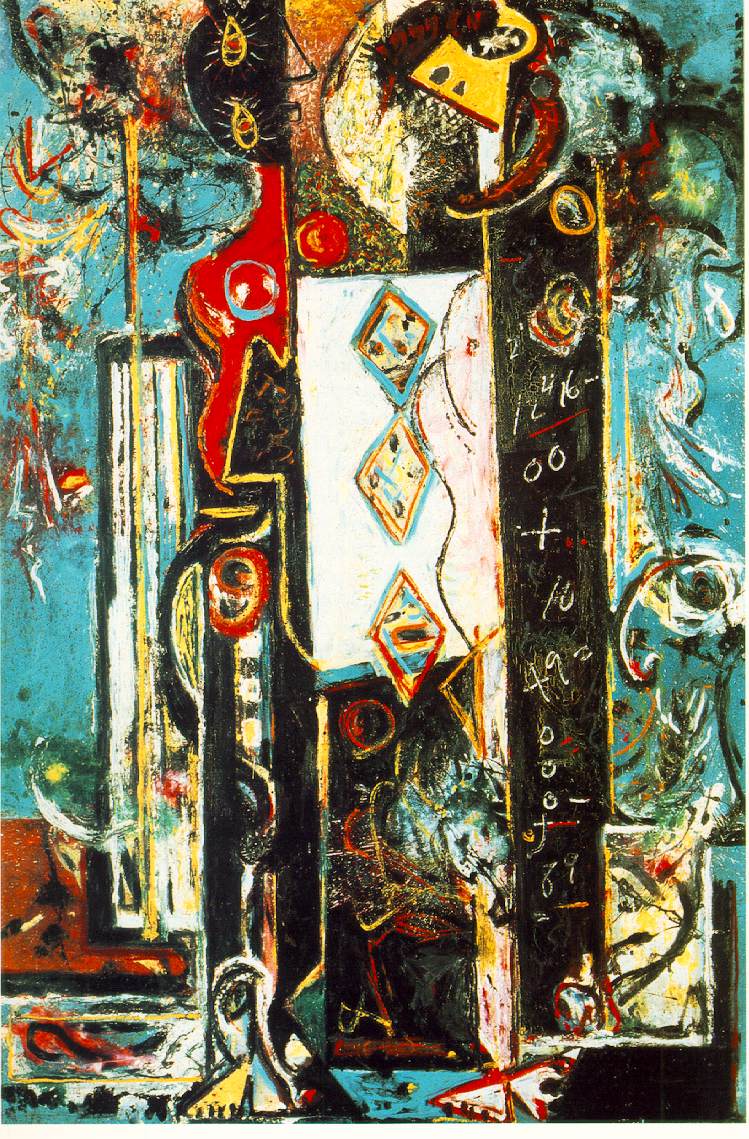
Pollock was introduced to the use of liquid paint in 1936, at an experimental workshop operated in New York City by the Mexican muralist David Alfaro Siqueiros. He later used paint pouring as one of several techniques in canvases of the early 1940s, such as "Male and Female" and "Composition with Pouring I." After his move to Springs, he began painting with his canvases laid out on the studio floor, and developed what was later called his "drip" technique. The drip technique required paint with a fluid viscosity so Pollock turned to then new synthetic resin-based paints, called alkyd enamels. Pollock described this use of household paints, instead of artist’s paints, as "a natural growth out of a need".[3] He used hardened brushes, sticks and even basting syringes as paint applicators. Pollock's technique of pouring and dripping paint is thought to be one of the origins of the term action painting. With this technique, Pollock was able to achieve a more immediate means of creating art, the paint now literally flowing from his chosen tool onto the canvas. By defying the conventional way of painting on an upright surface, he added a new dimension, literally, by being able to view and apply paint to his canvases from all directions.
In the process of making paintings in this way he moved away from figurative representation, and challenged the Western tradition of using easel and brush, as well as moving away from use only of the hand and wrist; as he used his whole body to paint. In 1956 Time magazine dubbed Pollock "Jack the Dripper" as a result of his unique painting style.[4]
| “ | My painting does not come from the easel. I prefer to tack the unstretched canvas to the hard wall or the floor. I need the resistance of a hard surface. On the floor I am more at ease. I feel nearer, more part of the painting, since this way I can walk around it, work from the four sides and literally be in the painting. | ” |
| “ | I continue to get further away from the usual painter's tools such as easel, palette, brushes, etc. I prefer sticks, trowels, knives and dripping fluid paint or a heavy impasto with sand, broken glass or other foreign matter added. | ” |
| “ | When I am in my painting, I'm not aware of what I'm doing. It is only after a sort of 'get acquainted' period that I see what I have been about. I have no fear of making changes, destroying the image, etc., because the painting has a life of its own. I try to let it come through. It is only when I lose contact with the painting that the result is a mess. Otherwise there is pure harmony, an easy give and take, and the painting comes out well. | ” |

Pollock observed Indian sandpainting demonstrations in the 1940s. Other influences on his dripping technique include the Mexican muralists and also Surrealist automatism. Pollock denied "the accident"; he usually had an idea of how he wanted a particular piece to appear. It was about the movement of his body, over which he had control, mixed with the viscous flow of paint, the force of gravity, and the way paint was absorbed into the canvas. The mix of the uncontrollable and the controllable. Flinging, dripping, pouring, spattering, he would energetically move around the canvas, almost as if in a dance, and would not stop until he saw what he wanted to see. Studies by Taylor, Micolich and Jonas have explored the nature of Pollock's technique and have determined that some of these works display the properties of mathematical fractals; and that the works become more fractal-like chronologically through Pollock's career.[5] They even go on to speculate that on some level, Pollock may have been aware of the nature of chaotic motion, and was attempting to form what he perceived as a perfect representation of mathematical chaos - more than ten years before Chaos Theory itself was discovered. Even though some experts have pointed to the possibility that he (Pollock) could have simply been imitating popular theories of the time in order to give his paintings a depth not previously seen.
In 1950 Hans Namuth, a young photographer, wanted to photograph and film Pollock at work. Pollock promised to start a new painting especially for the photographic session, but when Namuth arrived, Pollock apologized and told him the painting was finished. Namuth's comment upon entering the studio:
| “ | A dripping wet canvas covered the entire floor. . . . There was complete silence. . . . Pollock looked at the painting. Then, unexpectedly, he picked up can and paint brush and started to move around the canvas. It was as if he suddenly realized the painting was not finished. His movements, slow at first, gradually became faster and more dance like as he flung black, white, and rust colored paint onto the canvas. He completely forgot that Lee and I were there; he did not seem to hear the click of the camera shutter. . . My photography session lasted as long as he kept painting, perhaps half an hour. In all that time, Pollock did not stop. How could one keep up this level of activity? Finally, he said 'This is it.' | ” |
| “ | Pollock’s finest paintings… reveal that his all-over line does not give rise to positive or negative areas: we are not made to feel that one part of the canvas demands to be read as figure, whether abstract or representational, against another part of the canvas read as ground. There is not inside or outside to Pollock’s line or the space through which it moves…. Pollock has managed to free line not only from its function of representing objects in the world, but also from its task of describing or bounding shapes or figures, whether abstract or representational, on the surface of the canvas.(Karmel 132) | ” |

Pollock's most famous paintings were during the "drip period" between 1947 and 1950. He rocketed to popular status following an August 8, 1949 four-page spread in Life Magazine that asked, "Is he the greatest living painter in the United States?" At the peak of his fame, Pollock abruptly abandoned the drip style.[6]
Pollock's work after 1951 was darker in color, including a collection in black on unprimed canvases, followed by a return to color[7] and he reintroduced figurative elements. During this period Pollock had moved to a more commercial gallery and there was great demand from collectors for new paintings. In response to this pressure, along with personal frustration, his alcoholism deepened.[citation needed]
From naming to numbering
Pollock wanted an end to the viewer's search for representational elements in his paintings, thus he abandoned naming them and started numbering them instead. Of this, Pollock commented: "...look passively and try to receive what the painting has to offer and not bring a subject matter or preconceived idea of what they are to be looking for." Pollock's wife, Lee Krasner, said Pollock "used to give his pictures conventional titles... but now he simply numbers them. Numbers are neutral. They make people look at a picture for what it is - pure painting."[3]

Pollock did not paint at all in 1955.[7] After struggling with alcoholism his whole life, Pollock's career was cut short when he died in an alcohol-related, single car crash in his Oldsmobile convertible, less than a mile from his home in Springs, New York on August 11, 1956 at the age of 44. One of his passengers, Edith Metzger, died, while the other passenger, Pollock's girlfriend Ruth Kligman, survived. After his death, Pollock's wife, Lee Krasner, managed his estate and ensured that Pollock's reputation remained strong in spite of changing art-world trends. They are buried in Green River Cemetery in Springs with a large boulder marking his grave and a smaller one marking hers.

The Pollock-Krasner House and Studio is owned and administered by the Stony Brook Foundation, a non-profit affiliate of the State University of New York at Stony Brook. There are regular tours of the house and studio from May - October.
A separate organization, the Pollock-Krasner Foundation, was established in 1985. The Foundation not only functions as the official Estate for both Pollock and his widow Lee Krasner, but also, under the terms of Krasner's will, serves "to assist individual working artists of merit with financial need."[8] The U.S. copyright representative for the Pollock-Krasner Foundation is the Artists Rights Society[9].
In 2000, the biographical film Pollock was released. Marcia Gay Harden won the Academy Award for Best Supporting Actress for her portrayal of Lee Krasner. The movie was the project of Ed Harris who portrayed Pollock and directed it. He was nominated for Academy Award for Best Actor.
In 1960, Ornette Coleman's album "Free Jazz" featured a Pollock painting as its cover artwork.
In 1973, Blue Poles (Blue Poles: Number 11, 1952), was purchased by the Australian Whitlam Government for the National Gallery of Australia for US$2 million (A$1.3 million at the time of payment). At the time, this was the highest price ever paid for a modern painting. In the conservative climate of the time, the purchase created a political and media scandal.
The painting is now one of the most popular exhibits in the gallery, and now is thought to be worth between $100 and $150 million, according to the latest news.[10] It was a centerpiece of the Museum of Modern Art's 1998 retrospective in New York, the first time the painting had returned to America since its purchase.
In November 2006 Pollock's "No. 5, 1948" became the world's most expensive painting, when it was sold privately to an undisclosed buyer for the sum of $140,000,000. The previous owner was film and music-producer David Geffen. It is rumored that the current owner is a German businessman and art collector.
An ongoing debate rages over whether 24 paintings and drawings found in a Wainscott, New York locker in 2003 are Pollock originals. Physicists have argued over whether fractals can be used to authenticate the paintings. Analysis of the pigments shows some were not yet patented at the time of Pollock's death. The debate is still inconclusive.[11][12]
In 2006 a documentary, Who the Fuck Is Jackson Pollock?, was released which featured a truck driver named Teri Horton who bought what may be a Pollock painting worth millions at a thrift store for five dollars.
Relationship to Native American art
Pollock stated: “I feel nearer, more a part of the painting, since this way I can walk round it, work from the four sides and literally be in the painting. This is akin to the methods of the Indian sand painters of the West.” [13]
Pollock's work has always polarized critics and has been the focus of many important critical debates.
In a famous 1952 article in ARTnews, Harold Rosenberg coined the term "action painting," and wrote that "what was to go on the canvas was not a picture but an event. The big moment came when it was decided to paint 'just to paint.' The gesture on the canvas was a gesture of liberation from value — political, aesthetic, moral." Many people assumed that he had modeled his "action painter" paradigm on Pollock.
Clement Greenberg supported Pollock's work on formalistic grounds. It fit well with Greenberg's view of art history as being about the progressive purification in form and elimination of historical content. He therefore saw Pollock's work as the best painting of its day and the culmination of the Western tradition going back via Cubism and Cézanne to Manet.
Posthumous exhibitions of Pollock's work had been sponsored by the Congress for Cultural Freedom, an organization to promote American culture and values backed by the CIA. Certain left wing scholars, most prominently Eva Cockcroft, argue that the U.S. government and wealthy elite embraced Pollock and abstract expressionism in order to place the United States firmly in the forefront of global art and devalue socialist realism.[14][15] In the words of Cockcroft, Pollock became a 'weapon of the Cold War'.[16]
Painter Norman Rockwell's work Connoisseur[17] also appears to make a commentary on the Pollock style. The painting features what seems to be a rather upright man in a suit standing before a Jackson Pollock-like splatter painting.
Others such as artist, critic, and satirist Craig Brown, have been "astonished that decorative 'wallpaper', essentially brainless, could gain such a position in art history alongside Giotto, Titian, and Velázquez."[18]
Reynolds News in a 1959 headline said, "This is not art — it's a joke in bad taste." [19]
- (1942) Male and Female Philadelphia Museum of Art [1]
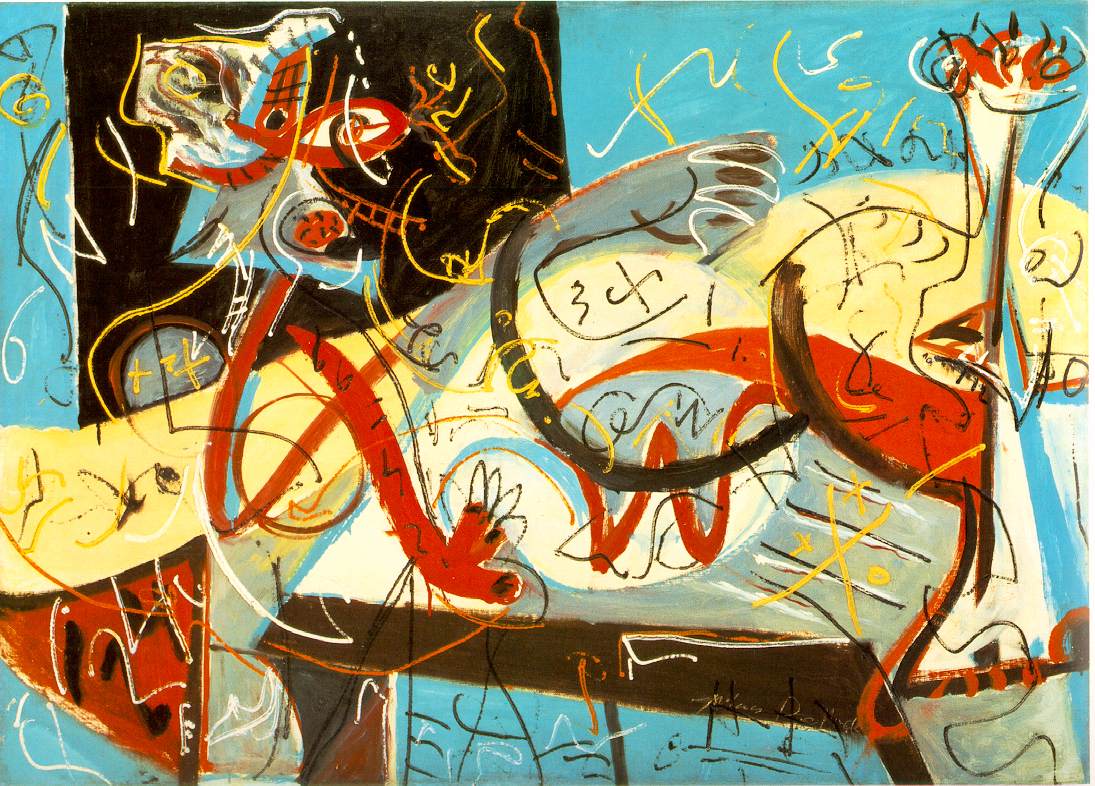
- (1942) Stenographic Figure Museum of Modern Art [2]
- (1943) Mural University of Iowa Museum of Art [3]
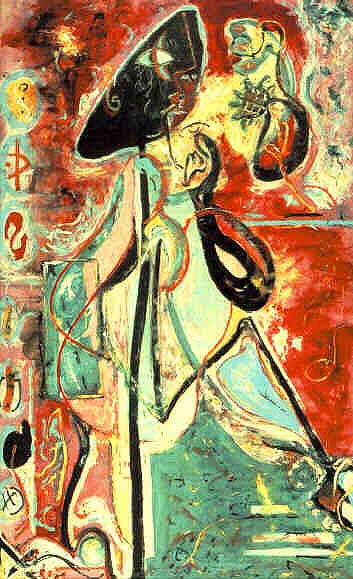
- (1943) Moon-Woman Cuts the Circle [4]
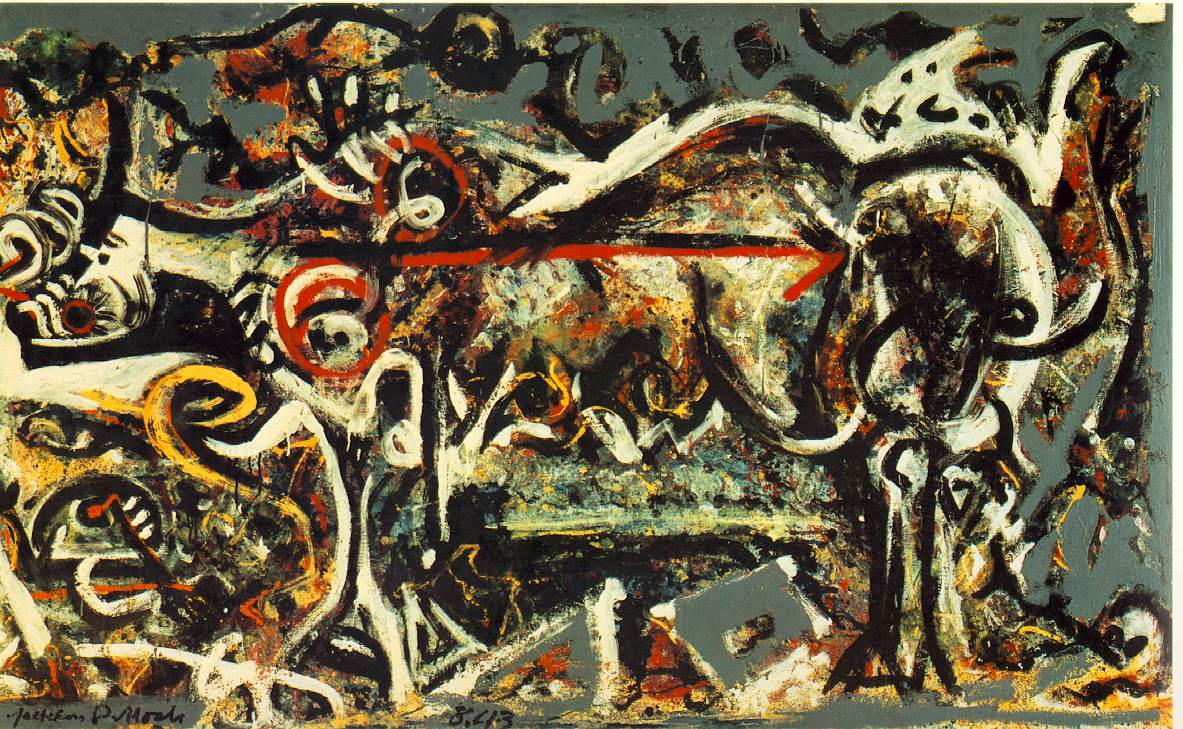
- (1943) The She-Wolf Museum of Modern Art [5]
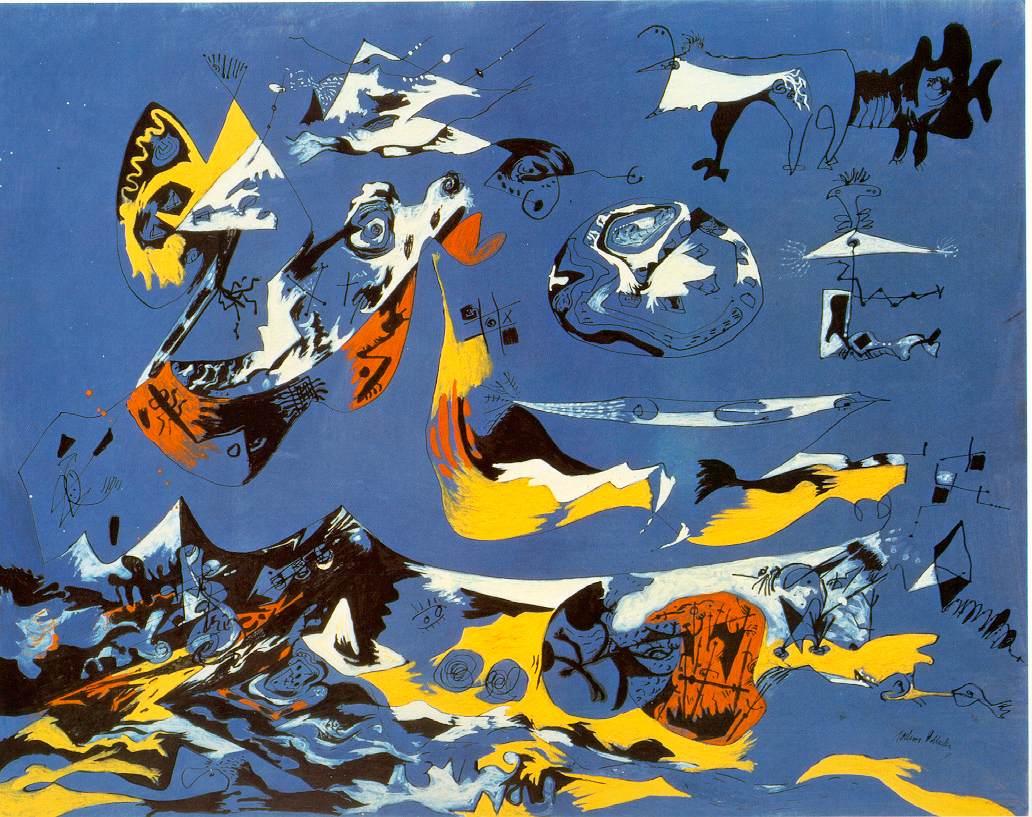
- (1943) Blue (Moby Dick) Ohara Museum of Art [6]
- (1945) Troubled Queen Museum of Fine Arts, Boston [7]
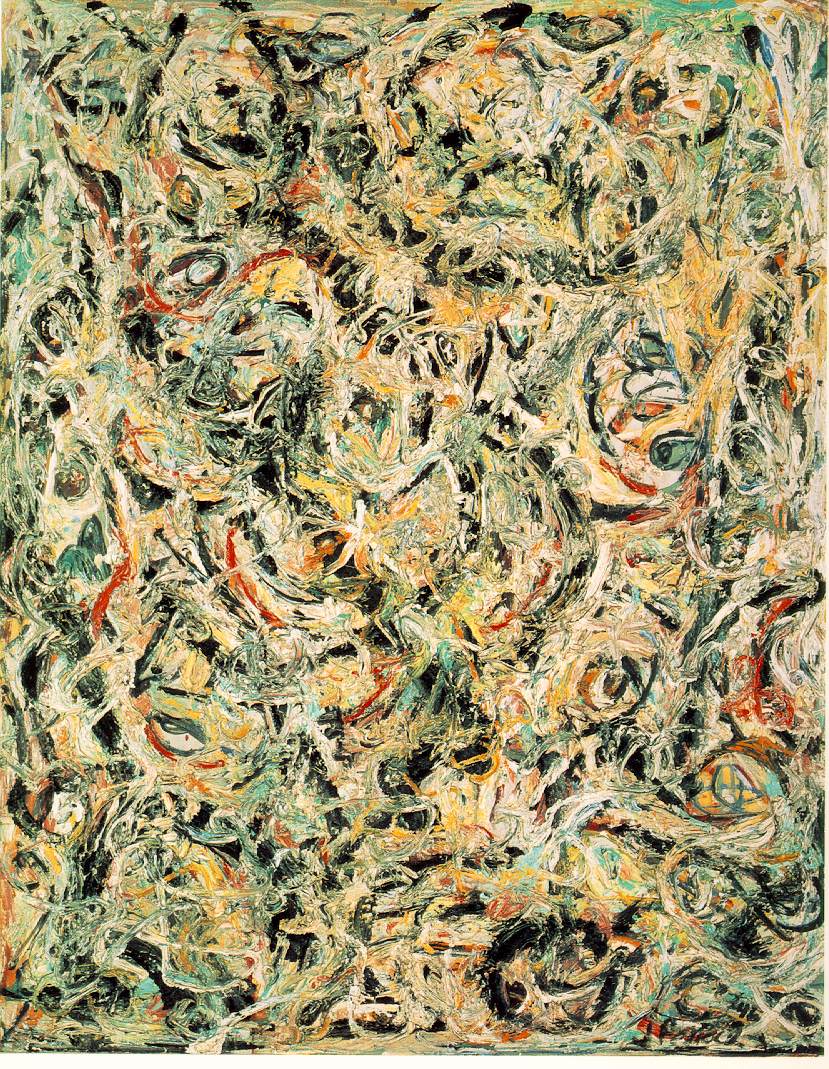
- (1946) Eyes in the Heat Peggy Guggenheim Collection, Venice [8]
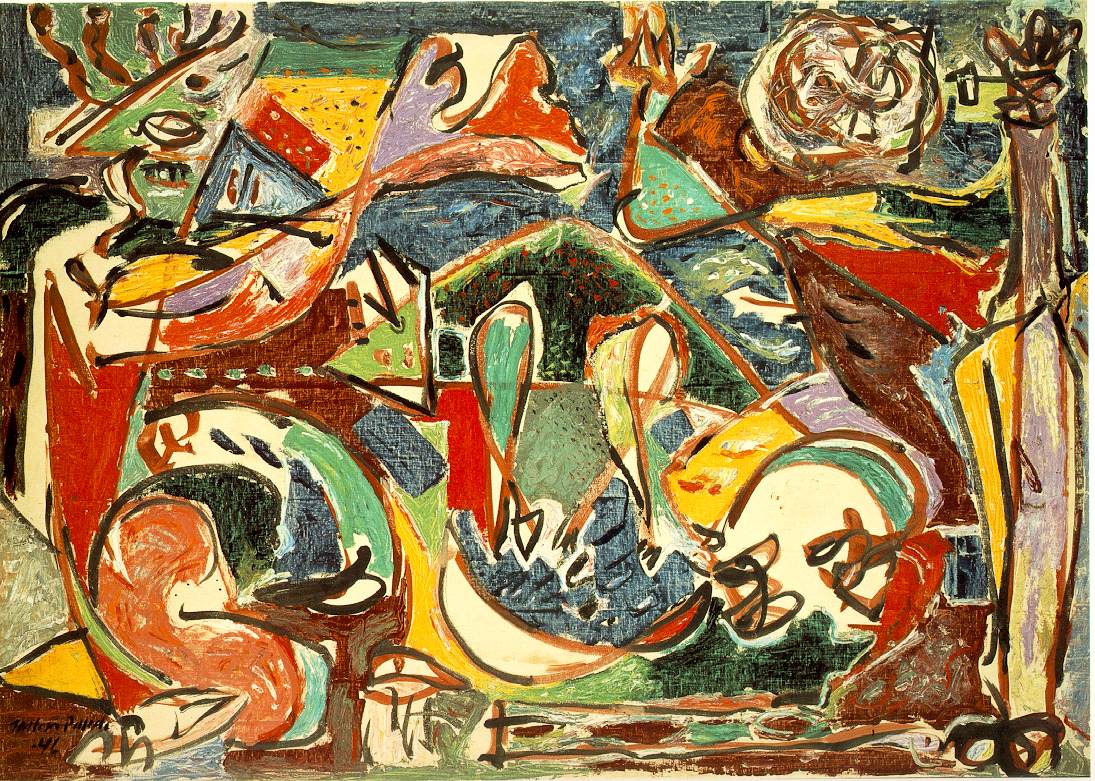
- (1946) The Key Art Institute of Chicago [9]
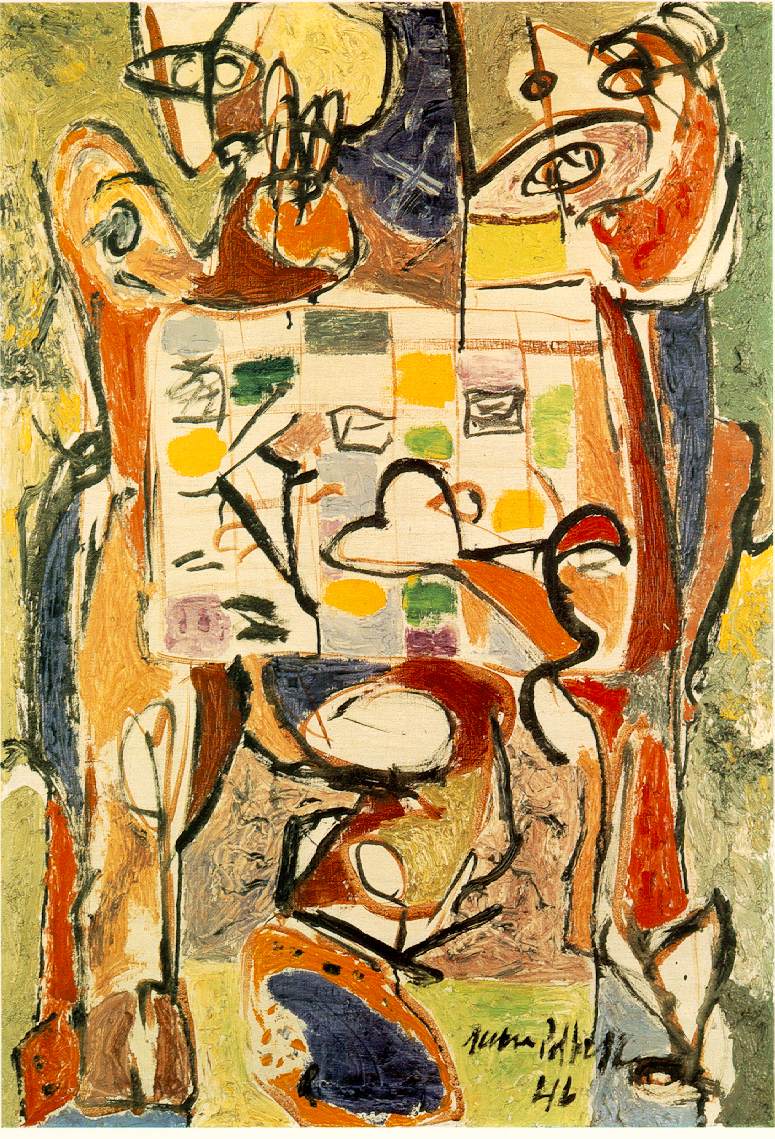
- (1946) The Tea Cup Collection Frieder Burda [10]
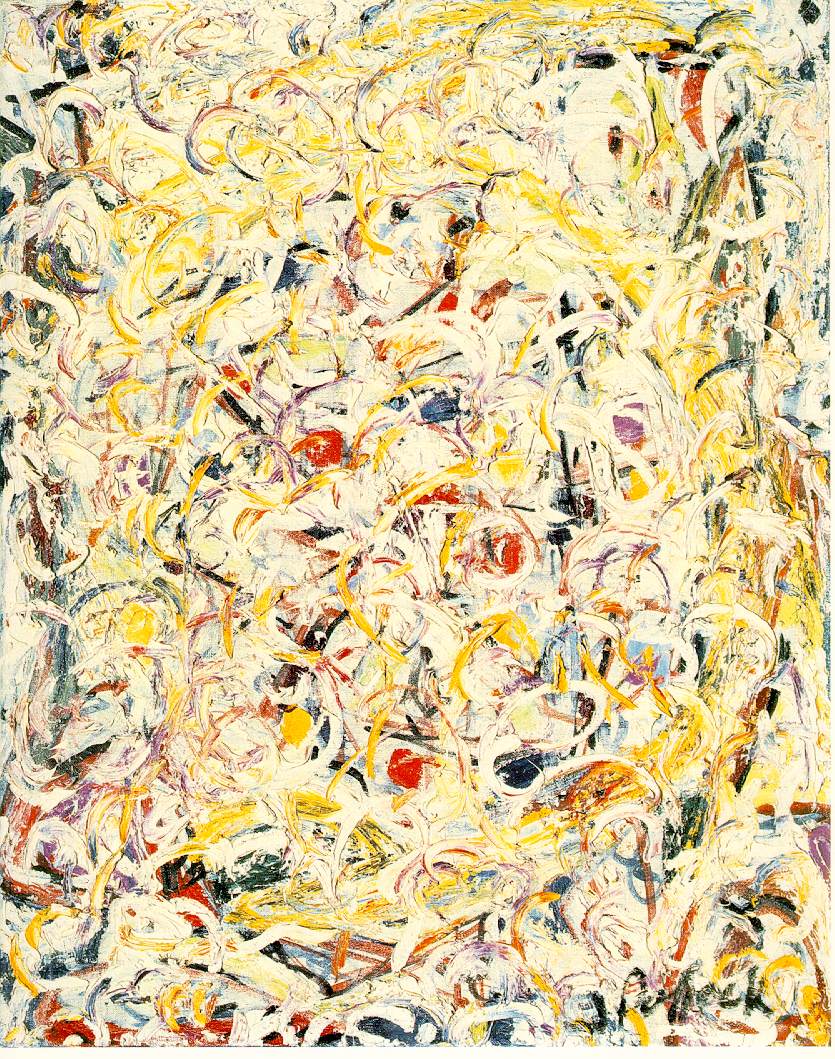
- (1946) Shimmering Substance, from The Sounds In The Grass Museum of Modern Art [11]
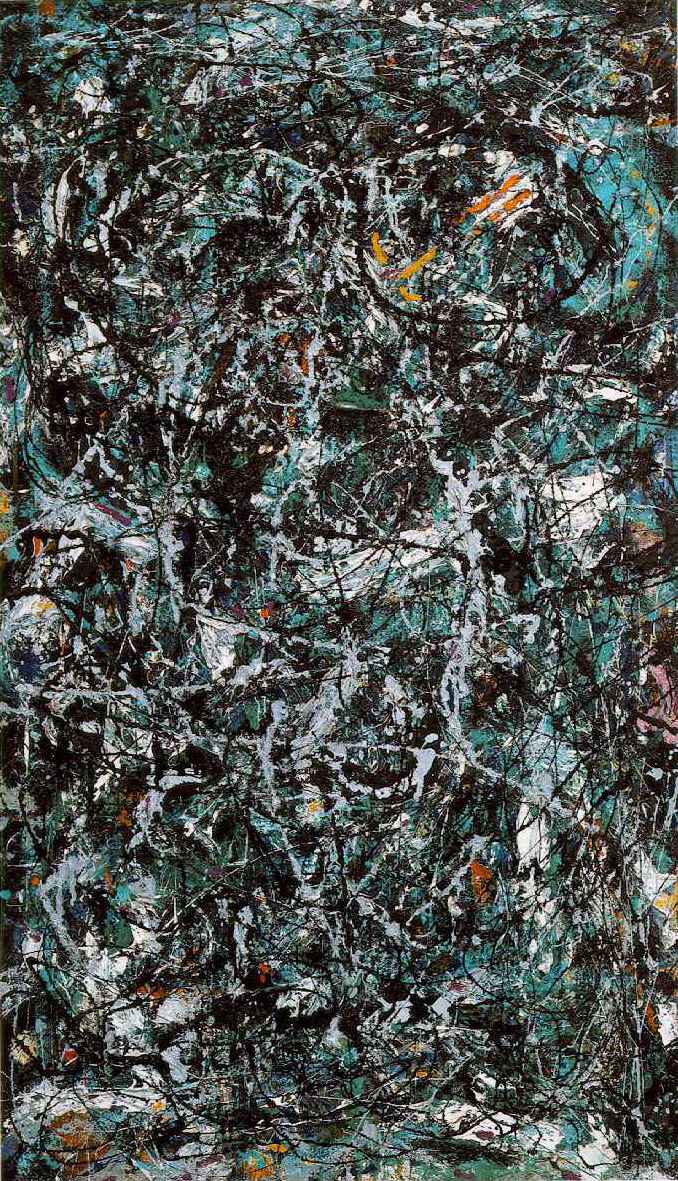
- (1947) Full Fathom Five Museum of Modern Art [12]
- (1947) Cathedral [13]
- (1947) Enchanted Forest Peggy Guggenheim Collection [14]
- (1948) Painting [15]
- (1948) Number 5 (4ft x 8ft) Private collection
- (1948) Number 8 [16]
- (1948) Summertime: Number 9A Tate Modern [17]
- (1949) Number 1 Museum of Contemporary Art, Los Angeles [18]
- (1949) Number 3
- (1949) Number 10 Museum of Fine Arts, Boston [19]
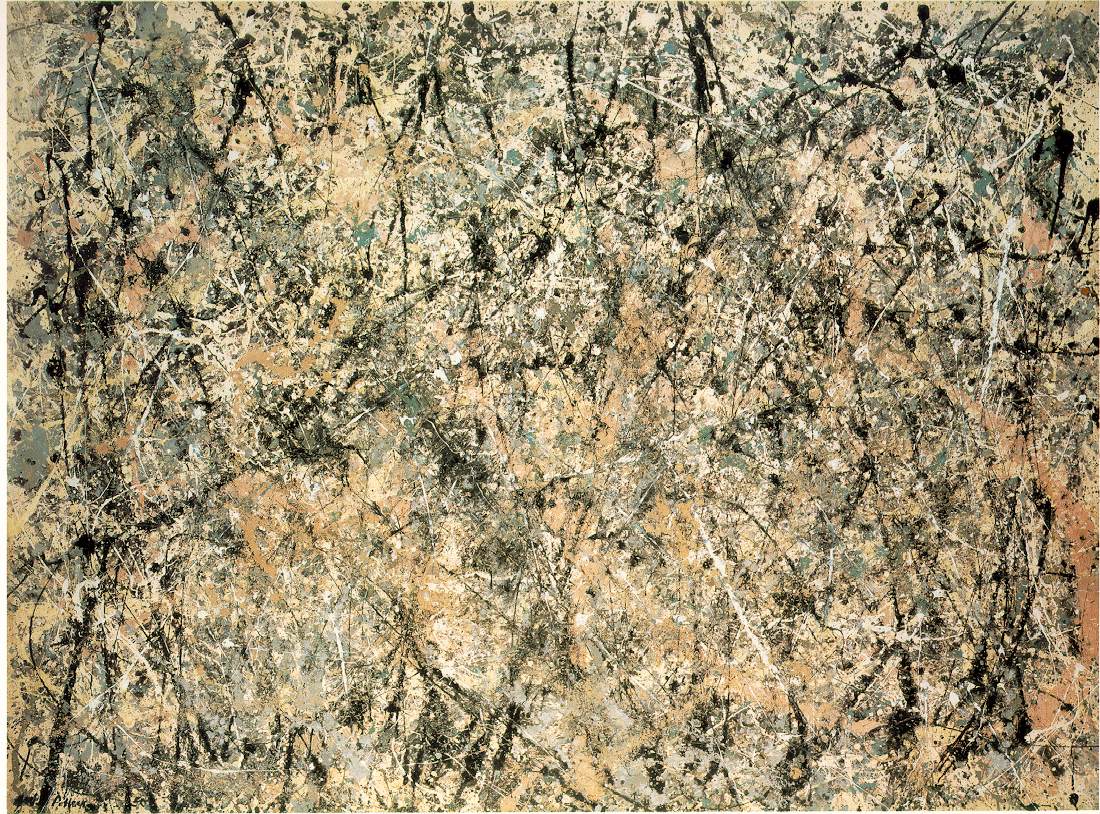
- (1950) Number 1, 1950 (Lavender Mist) National Gallery of Art [20]
- (1950) Autumn Rhythm (Number 30), 1950 Metropolitan Museum of Art [21]
- (1950) Number 29, 1950 National Gallery of Canada [22]
- (1950) One: Number 31, 1950 Museum of Modern Art [23]
- (1950) No. 32 [24]
- (1951) Number 7 National Gallery of Art [25]
- (1952) Convergence Albright-Knox Art Gallery [26]
- (1952) Blue Poles: No. 11, 1952 National Gallery of Australia[27]
- (1953) Portrait and a Dream [28]
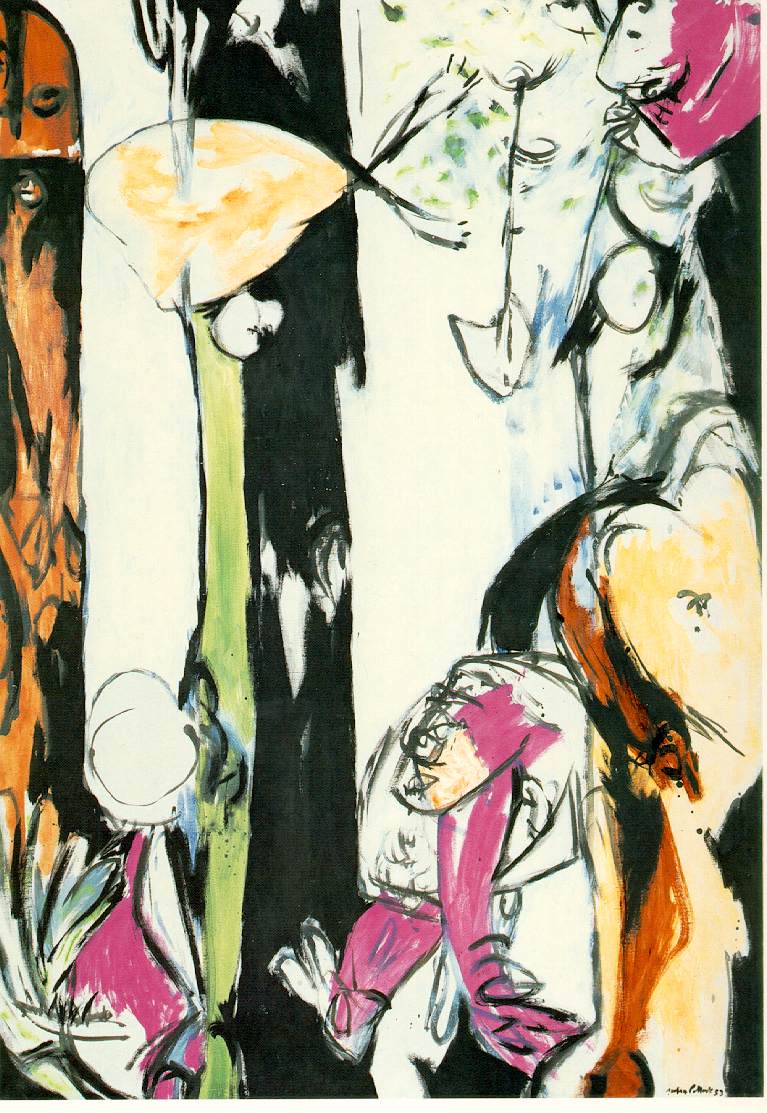
- (1953) Easter and the Totem The Museum of Modern Art [29]
- (1953) Ocean Greyness [30]
- (1953) The Deep
Tuesday, October 7, 2008
Salvador Dalí
Salvador Domingo Felipe Jacinto Dalí i Domènech, 1st Marquis of Púbol (May 11, 1904 – January 23, 1989), was a Spanish [1] Catalan surrealist painter born in Figueres. Dalí was a skilled draftsman, best known for the striking and bizarre images in his surrealist work. His painterly skills are often attributed to the influence of Renaissance masters.[2][3] His best known work, The Persistence of Memory, was completed in 1931. Salvador Dalí's artistic repertoire also included film, sculpture, and photography. He collaborated with Walt Disney on the unfinished Academy Award-nominated short cartoon Destino, which was completed and released posthumously in 2003. He also collaborated with Alfred Hitchcock on the dream sequence from his 1945 film Spellbound.
Dalí insisted on his "Arab lineage", claiming that his ancestors were descended from the Moors who occupied Southern Spain for nearly 800 years (711-1492), and attributed to these origins, "my love of everything that is gilded and excessive, my passion for luxury and my love of oriental clothes."
Widely considered to be greatly imaginative, Dalí had an affinity for doing unusual things to draw attention to himself. This sometimes irked those who loved his art as much as it annoyed his critics, since his eccentric manner sometimes drew more public attention than his artwork.[5] The purposefully-sought notoriety led to broad public recognition and many purchases of his works by people from all walks of life.
Biography
Early life
Salvador Domingo Felipe Jacinto Dalí i Domènech, was born on May 11, 1904, at 8:45 a.m. GMT[6] in the town of Figueres, in the Empordà region close to the French border in Catalonia, Spain.[7] Dalí's older brother, also named Salvador (b. October 12, 1901), had died of gastroenteritis, nine months earlier, on August 1, 1903. His father, Salvador Dalí i Cusí, was a middle-class lawyer and notary[8] whose strict disciplinarian approach was tempered by his wife, Felipa Domenech Ferrés, who encouraged her son's artistic endeavors.[9] When he was five, Dalí was taken to his brother's grave and told by his parents that he was his brother's reincarnation,[10] which he came to believe.[11] Of his brother, Dalí said: "… [we] resembled each other like two drops of water, but we had different reflections."[12] He "was probably a first version of myself but conceived too much in the absolute."[13]
Dalí also had a sister, Ana María, who was three years younger.[8] In 1949 she published a book about her brother, Dalí As Seen By His Sister.[14] His childhood friends included future FC Barcelona footballers, Sagibarbá and Josep Samitier. During holidays at the Catalan resort of Cadaqués, the trio played football together.
Dalí attended drawing school. In 1916 Dalí also discovered modern painting on a summer vacation to Cadaqués with the family of Ramon Pichot, a local artist who made regular trips to Paris.[8] The next year, Dalí's father organized an exhibition of his charcoal drawings in their family home. He had his first public exhibition at the Municipal Theater in Figueres in 1919.
In February 1921, Dalí's mother died of breast cancer. Dalí was sixteen years old; he later said his mother's death "was the greatest blow I had experienced in my life. I worshipped her … I could not resign myself to the loss of a being on whom I counted to make invisible the unavoidable blemishes of my soul."[15] After her death, Dalí's father married his deceased wife's sister. Dalí did not resent this marriage as some do think, because he had a great love and respect toward his aunt.[8]
Madrid and Paris

In 1922, Dalí moved into the Residencia de Estudiantes (Students' Residence) in Madrid[8] and there studied at the Academia de San Fernando (School of Fine Arts). A lean 1.72 m (5 ft 8 in) [16] tall dandy, Dalí already drew attention as an eccentric, wearing long hair and sideburns, coat, stockings and knee breeches in the fashion style of the English aesthetes of the late 19th century. But his paintings, where he experimented with Cubism, earned him the most attention from his fellow students. In these earliest Cubist works, he probably did not completely understand the movement, since his only information on Cubist art came from a few magazine articles and a catalog given to him by Pichot, and there were no Cubist artists in Madrid at the time.
In 1924 the still unknown Salvador Dalí illustrated for the first time a book. It was the Catalan poem "Les bruixes de Llers" ("The Witches of Llers") by his friend and schoolmate, the poet Carles Fages de Climent.
Dalí also experimented with Dada, which influenced his work throughout his life. At the Residencia, he became close friends with, among others, Pepín Bello, Luis Buñuel, and the poet Federico García Lorca. The friendship with Lorca had a strong element of mutual passion,[17] but Dalí fearfully rejected the erotic advances of the poet.[18]
Dalí was expelled from the Academia in 1926 shortly before his final exams when he stated that no one on the faculty was competent enough to examine him.[19] His mastery of painting skills is well documented by that time in his flawlessly realistic Basket of Bread, which was painted in 1926.[20] That same year he made his first visit to Paris where he met with Pablo Picasso, whom young Dalí revered. Picasso had already heard favorable things about Dalí from Joan Miró. Dalí did a number of works heavily influenced by Picasso and Miró over the next few years as he developed his own style.
Some trends in Dalí's work that would continue throughout his life were already evident in the 1920s. Dalí devoured influences from many styles of art and then produced works ranging from the most academically classic, evidencing a familiarity with Raphael, Bronzino, Francisco de Zurbaran, Vermeer, and Velázquez,[21] to the most cutting-edge avant-garde,[22] sometimes in separate works and sometimes combined. Exhibitions of his works in Barcelona attracted much attention and mixtures of praise and puzzled debate from critics.
Dalí grew a flamboyant moustache, which became iconic of him; it was influenced by that of seventeenth century Spanish master painter Diego Velázquez.
1929 through World War II
In 1929, Dalí collaborated with the surrealistic film director Luis Buñuel on the short film Un chien andalou (An Andalusian Dog). His main contribution was helping Buñuel write the script for the film. Dalí later claimed to have been more heavily involved in the filming of the project, but this is not substantiated by contemporary accounts.[23] Also that year, in August, he met his muse, inspiration, and future wife Gala,[24] born Elena Ivanovna Diakonova, a Russian immigrant eleven years his senior who was then married to the surrealist poet Paul Éluard. In the same year, Dalí had important professional exhibitions and officially joined the surrealist group in the Montparnasse quarter of Paris (although his work had already been heavily influenced by surrealism for two years). The surrealists hailed what Dalí called the Paranoiac-critical method of accessing the subconscious for greater artistic creativity.[8][9]
Meanwhile, Dalí's relationship with his father was close to rupture. Don Salvador Dalí y Cusi strongly disapproved of his son's romance with Gala and his connection to the Surrealists, a bad influence on his morals. The last straw was when Don Salvador read in a Barcelona paper that his son had recently exhibited in Paris a drawing picturing the Sacred Heart of Jesus Christ with the provocative saying: "Sometimes, I spit for fun on my mother's portrait". Outraged, Don Salvador demanded that his son recant publicly. Dali refused, perhaps for fear of expulsion from the Surrealist group, and was violently thrown out of his paternal home on December 28, 1929. His father told him that he would disinherit him and that he should never set foot in Cadaquès again. Some say that, upon hearing the bad news, an enraged Dalí handed to his father a condom with his own sperm inside, saying "Take that. I owe you nothing anymore!" The following summer Dalí and Gala would rent a small fisherman's cabin in a nearby bay at Port Lligat. He bought the place and over the years he enlarged it little by little, building his much beloved villa by the sea.
In 1931, Dalí painted one of his most famous works, The Persistence of Memory.[25] Sometimes called Soft Watches or Melting Clocks[citation needed], the work introduced the surrealistic image of the soft, melting pocket watch. The general interpretation of the work is that the soft watches debunk the assumption that time is rigid or deterministic, and this sense is supported by other images in the work, such as the wide expanding landscape and the ants and fly devouring the other watches.[26]
Dalí and Gala, having lived together since 1929, were married in 1934 in a civil ceremony (They remarried in a Catholic ceremony in 1958).
Dalí was introduced to America by art dealer Julian Levy in 1934, and the exhibition of Dalí works (including Persistence) in New York created an immediate sensation. Social Register listees feted him at a specially organized "Dalí Ball". He showed up wearing on his chest a glass case containing a brassiere. [27] In 1936, Dalí took part in the London International Surrealist Exhibition. His lecture entitled Fantomes paranoiaques authentiques was delivered wearing a deep-sea diving suit.[28] He had arrived carrying a billiard cue and leading a pair of Russian wolfhounds, and had to have the helmet unscrewed as he gasped for breath. He commented that "I just wanted to show that I was 'plunging deeply' into the human mind." [29]
According to Luis Buñuel, Dalí and Gala went to a masquerade party in Chicago dressed as the Lindbergh baby and the kidnapper. The uproar in the press was so great that Dalí apologized; when he returned to Paris, the Surrealists put him on trial for apologizing for a surrealist act. [30]
André Breton accused Dalí of defending the "new" and "irrational" in the "the Hitler phenomenon", but the artist quickly rejected this claim saying, "I am Hitlerian neither in fact nor intention."[31] However, when Francisco Franco came to power in the aftermath of the Spanish Civil War, Dalí's support of the new regime, among other things, eventually resulted in his purported expulsion from the surrealist group.[24] At this, Dalí retorted, "I myself am surrealism."[19] André Breton coined the anagram "avida dollars" (for Salvador Dalí), which more or less translates to "eager for dollars,"[32] by which he referred to Dalí after the period of his expulsion. The surrealists henceforth spoke of Dalí in the past tense, as if he was dead. At this stage his main patron was the very wealthy Edward James. The surrealist movement and various members thereof (such as Ted Joans) would continue to issue extremely harsh polemics against Dalí until the time of his death and beyond.
Edward James helped the young Salvador Dalí emerge into the art world by purchasing many works and supporting him financially for two years. They became good friends and James features in Dalí's painting ‘Swans Reflecting Elephants.’ They also collaborated on two of the most enduring icons of the Surrealist movement: the Lobster Telephone and the Mae West Lips Sofa.
"During this period Dalí never stopped writing", wrote Robert and Nicolas Descharnes. [33] In 1941, he drafted a film scenario for Jean Gabin called Moontide. He wrote catalogs for his exhibitions like that at the Knoedler Gallery [in New York City in 1943] where he expounded, 'Surrealism will at least have served to give experimental proof that total sterility and attempts at automatizations have gone too far and have led to a totalitarian system. ... Today's laziness and the total lack of technique have reached their paroxysm in the psychological signification of the current use of the college.' He also wrote a novel (published in 1944) about a fashion salon for automobiles. This got a drawing by Edwin Cox in The Miami Herald showing him dressing an automobile in an evening gown."[34]
In 1940, as World War II started in Europe, Dalí and Gala moved to the United States, where they lived for eight years. After the move, Dalí returned to the practice of Catholicism. In 1942, he published his autobiography, The Secret Life of Salvador Dalí. An Italian friar, Gabriele Maria Berardi, claimed to have performed an exorcism on Dalí while he was in France in 1947.[35] The friar's estate contained a sculpture of Christ on the cross which Dalí had given his exorcist to thank him.[35] The sculpture was discovered in 2005 and two Spanish experts in Surrealism confirmed that there were adequate stylistic reasons to believe the sculpture was made by Dalí.[35]
Later years in Catalonia
Starting in 1949, Dalí spent his remaining years back in his beloved Catalonia. The fact that he chose to live in Spain while it was ruled by Franco drew criticism from progressives and many other artists.[36] As such, it is probable that at least some of the common dismissal of Dalí's later works had more to do with politics than the actual merits of the works themselves. In 1959, André Breton organized an exhibit called, Homage to Surrealism, celebrating the Fortieth Anniversary of Surrealism, which contained works by Salvador Dalí, Joan Miró, Enrique Tábara, and Eugenio Granell. Breton vehemently fought against the inclusion of Dalí's Sistine Madonna in the International Surrealism Exhibition in New York the following year.[37]
Late in his career, Dalí did not confine himself to painting but experimented with many unusual or novel media and processes: he made bulletist works[38] and was among the first artists to employ holography in an artistic manner.[39] Several of his works incorporate optical illusions. In his later years, young artists like Andy Warhol proclaimed Dalí an important influence on pop art.[40] Dalí also had a keen interest in natural science and mathematics. This is manifested in several of his paintings, notably in the 1950s when he painted his subjects as composed of rhinoceros horns, signifying divine geometry (as the rhinoceros horn grows according to a logarithmic spiral) and chastity (as Dalí linked the rhinoceros to the Virgin Mary).[41] Dalí was also fascinated by DNA and the hypercube - a 4-dimensional cube - and an unfolding of a hypercube is featured in the painting Crucifixion (Corpus Hypercubus).
Dalí's post-World War II period bore the hallmarks of technical virtuosity and an interest in optical illusions, science and religion. Increasingly Catholic, and inspired by the shock of Hiroshima, he labeled this period "Nuclear Mysticism". In paintings such as The Madonna of Port-Lligat (first version) of 1949 and Corpus Hypercubus, 1954, Dalí sought to synthesize Christian iconography with images of material disintegration inspired by nuclear physics.[42] "Nuclear Mysticism" included such notable pieces as La Gare de Perpignan, 1965, and Hallucinogenic Toreador, 1968–1970. In 1960, Dalí began work on the Dalí Theatre and Museum in his home town of Figueres; it was his largest single project and the main focus of his energy through 1974. He continued to make additions through the mid-1980s.
In 1968, Dalí filmed a television advertisement for Lanvin chocolates[43] and in 1969 designed the Chupa Chups logo. Also in 1969, he was responsible for creating the advertising aspect of the 1969 Eurovision Song Contest, and created a large metal sculpture, which stood on the stage at the Teatro Real in Madrid.
In the television programme Dirty Dalì: A Private View broadcast on Channel 4 on June 3, 2007, the art critic Brian Sewell described his acquaintance with Dalí in the late 1960s, which included lying down in the fetal position without trousers in the armpit of a figure of Christ and masturbating for Dalí who pretended to take photos while fumbling in his own trousers.[44][45]
In 1980, Dalí's health took a catastrophic turn. His near-senile wife Gala was dosing him with a dangerous cocktail of non-prescribed medicine that damaged his nervous system, thus causing an untimely end to his artistic ability. At 76 years old, the 'ever-healthy' Dalí was a complete wreck, his right hand trembling terribly, Parkinson-like.[46]
In 1982, King Juan Carlos of Spain bestowed on Dalí the title Marquis of Pubol, for which Dalí later paid him by giving him a drawing (Head of Europa, which would turn out to be Dalí's final drawing) after the king visited him on his deathbed.
Gala died on June 10, 1982. After Gala's death, Dalí lost much of his will to live. He deliberately dehydrated himself—possibly as a suicide attempt, possibly in an attempt to put himself into a state of suspended animation, as he had read that some microorganisms could do. He moved from Figueres to the castle in Púbol which he had bought for Gala and was the site of her death. In 1984, a fire broke out in his bedroom[47] under unclear circumstances—possibly a suicide attempt by Dalí, possibly simple negligence by his staff.[19] In any case, Dalí was rescued and returned to Figueres where a group of his friends, patrons, and fellow artists saw to it that he was comfortable living in his Theater-Museum for his final years.


There have been allegations that his guardians forced Dalí to sign blank canvasses that would later (even after his death) be used and sold as originals.[48] As a result, art dealers tend to be wary of late works attributed to Dalí.
In November 1988 Dalí entered the hospital with heart failure and on December 5, 1988 was visited by King Juan Carlos who confessed that he had always been a serious devotee of Dalí.[49]
On January 23, 1989 while his favorite record of Tristan and Isolde played, he died of heart failure at Figueres, at the age of 84, and, coming full circle, is buried in the crypt of his Teatro Museo in Figueres, across the street from the church of Sant Pere where he had his funeral, first communion, and baptism, and three blocks from the house where he was born.[50]
The Gala-Salvador Dalí Foundation currently serves as his official Estate.[51]. The U.S. copyright representative for the Gala-Salvador Dalí Foundation is the Artists Rights Society[52]. In 2002, the Artists Rights Society made the news when they asked Google to remove customised version of its logo put up to commemorate Dalí, alleging that portions of specific artworks under their protection had been used in the logos, and that they were used without permission. Google complied with the request, but denied that there was any violation of copyright.
Symbolism
Dalí employed extensive symbolism in his work. For instance, the hallmark soft watches that first appear in The Persistence of Memory suggest Einstein's theory that time is relative and not fixed.[26] The idea for clocks functioning symbolically in this way came to Dalí when he was staring at a runny piece of Camembert cheese during a hot day in August.[53]
The elephant is also a recurring image in Dalí's works. It first appeared in his 1944 work Dream Caused by the Flight of a Bee around a Pomegranate a Second Before Awakening. The elephants, inspired by Gian Lorenzo Bernini's sculpture base in Rome of an elephant carrying an ancient obelisk,[54] are portrayed "with long, multi-jointed, almost invisible legs of desire"[55] along with obelisks on their backs. Coupled with the image of their brittle legs, these encumbrances, noted for their phallic overtones, create a sense of phantom reality. "The elephant is a distortion in space", one analysis explains, "its spindly legs contrasting the idea of weightlessness with structure."[55] … I am painting pictures which make me die for joy, I am creating with an absolute naturalness, without the slightest aesthetic concern, I am making things that inspire me with a profound emotion and I am trying to paint them honestly. —Salvador Dalí, in Dawn Ades, Dalí and Surrealism.
The egg is another common Dalíesque image. He connects the egg to the prenatal and intrauterine, thus using it to symbolize hope and love;[56] it appears in The Great Masturbator and The Metamorphosis of Narcissus. Various animals appear throughout his work as well: ants point to death, decay, and immense sexual desire; the snail is connected to the human head (he saw a snail on a bicycle outside Freud's house when he first met Sigmund Freud); and locusts are a symbol of waste and fear.[56]
Endeavors outside painting

Dalí was a versatile artist, not limiting himself only to painting in his artistic endeavors. Some of his more popular artistic works are sculptures and other objects, and he is also noted for his contributions to theatre, fashion, and photography, among other areas.
Two of the most popular objects of the surrealist movement were the Lobster Telephone and the Mae West Lips Sofa, completed by Dalí in 1936 and 1937, respectively. The Surrealist artist and patron Edward James commissioned both of these pieces from Dalí; James inherited a large English estate in West Dean, West Sussex when he was five and was one of the foremost supporters of the surrealists in the 1930s.[57] "Lobsters and telephones had strong sexual connotations for [Dalí]" according to the display caption for the Lobster Telephone at the Tate Gallery, "and he drew a close analogy between food and sex."[58] The telephone was functional, and James purchased four of them from Dalí to replace the phones in his retreat home. One now appears at the Tate Gallery; the second can be found at the German Telephone Museum in Frankfurt; the third belongs to the Edward James Foundation; and the fourth is at the National Gallery of Australia.[57]
The wood and satin Mae West Lips Sofa was shaped after the lips of actress Mae West, whom Dalí apparently found fascinating.[24] West was previously the subject of Dalí's 1935 painting The Face of Mae West. The Mae West Lips Sofa currently resides at the Brighton and Hove Museum in England.
During the years between 1941 and 1970 Dalí was also responsible for creating a striking ensemble of jewels, 39 in total. The jewels created are intricate and some contain actual moving parts. The most famous jewel created by Dalí, "The Royal Heart", is crafted using gold and is encrusted with forty-six rubies, forty-two diamonds and four emeralds, and is created in such a way that the center "beats" much like a real heart. Dalí himself commented that "Without an audience, without the presence of spectators, these jewels would not fulfill the function for which they came into being. The viewer, then, is the ultimate artist." (Dalí, 1959.) The "Dalí — Joies" ("The Jewels of Dalí") collection can be seen at the Dalí Theater Museum in Figueres, Catalonia, Spain, where it is on permanent exhibition.
In theatre, Dalí is remembered for constructing the scenery for García Lorca's 1927 romantic play Mariana Pineda.[59] For Bacchanale (1939), a ballet based on and set to the music of Richard Wagner's 1845 opera Tannhäuser, Dalí provided both the set design and the libretto.[60] Bacchanale was followed by set designs for Labyrinth in 1941 and The Three-Cornered Hat in 1949.[61]
Although most known for his paintings, Dalí became intensely interested in film when he was young; going to the theatre to see different shows almost every Sunday. He was part of the era where drawing on the medium of film became popular and silent films were being viewed. He believed there were two dimensions to the theories of film and cinema: ‘things themselves’-the facts that are presented in the world of the camera and ‘photographic imagination’- the way the camera shows the picture and how creative or imaginative it looks [62]. Dalí was active in front and behind the scenes in the film world. He created wonderful pieces of artwork such as Destino, on which he collaborated with Walt Disney. He is also credited as co-creator of Luis Buñuel's surrealist film Un Chien Andalou, a 17-minute French art film co-written with Luis Buñuel that is widely remembered for its graphic opening scene simulating the slashing of a human eyeball with a razor. This film is what Dalí is known for in the independent film world. Un Chien Andalou was Dalí's way of creating his dreamlike qualities in the real world. Images would change and scenes would switch leading the viewer in a completely different direction from the one they were previously viewing. The second film he produced with Buñuel was entitled L’age d’or and it was performed at Studio 28 in Paris in 1930. The film L’age d’or it was "banned for years after fascist and anti-Semitic groups staged a stink-bomb and ink-throwing riot in the Paris theater where it was shown." [63]. Although negative aspects of society were being thrown into the life of Dalí and obviously affecting the success of his artwork, it did not hold him back from expressing his own ideas and beliefs in his art. Both of these films, Un Chien Andalou and L’age d’or, have had a tremendous impact on the independent surrealist film movement. "If Un Chien Andalou stands as the supreme record of Surrealism's adventures into the realm of the unconscious, then L'Âge d'or is perhaps the most trenchant and implacable expression of its revolutionary intent." [64]. Dalí also worked with other famous filmmakers such as Alfred Hitchcock. The most well-known of his film projects is probably the dream sequence in Alfred Hitchcock's Spellbound, which heavily delves into themes of psychoanalysis. Hitchcock needed a dream-like quality to his movie which dealt with the idea that a repressed experience can directly trigger a neurosis, and he knew that Dalí's work would help create the atmosphere he wanted in his film. He also worked on a documentary called Chaos and Creation which has a lot of artistic references thrown into it to help one see what Dalí's vision of art really is. He also worked on a Disney cartoon production Destino; completed in 2003 by Baker Bloodworth and Roy Disney, it contains dream-like images of strange figures flying and walking about. It is based on the Mexican songwriter Armando Dominguez's song entitled ‘Destino’. When Disney hired Dalí to help produce Destino in 1946, they were not prepared for the work they had ahead of themselves. For eight months they continuously animated until their efforts had to come to a stop when they realized they were in financial trouble. They had no more money to finish the production of the animated movie; however, it was eventually finished and shown in various film festivals. The movie consists of Dalí's artwork interacting with Disney's classic princess-like character animation. Dalí completed only one other film in his lifetime: Impressions of Upper Mongolia (1975), in which he narrated a story about an expedition in search of giant hallucinogenic mushrooms. The imagery was based on microscopic uric acid stains on the brass band of a ballpoint pen on which Dalí had been urinating for several weeks.[65]
Dalí built a repertoire in the fashion and photography industries as well. In fashion, his cooperation with the Italian fashion designer Elsa Schiaparelli is well-known, where Dalí was hired by Schiaparelli to produce a white dress with a lobster print. Other designs Dalí made for her include a shoe-shaped hat and a pink belt with lips for a buckle. He was also involved in creating textile designs and perfume bottles. With Christian Dior in 1950, Dalí created a special "costume for the year 2045."[60] Photographers with whom he collaborated include Man Ray, Brassaï, Cecil Beaton, and Philippe Halsman.
With Man Ray and Brassaï, Dalí photographed nature; with the others, he explored a range of obscure topics, including with Halsman the Dalí Atomica series (1948)—inspired by his painting Leda Atomica—which in one photograph depicts "a painter's easel, three cats, a bucket of water and Dalí himself floating in the air."[60]
References to Dalí in the context of science are made in terms of his fascination with the paradigm shift that accompanied the birth of quantum mechanics in the twentieth century. Inspired by Werner Heisenberg's Uncertainty principle, in 1958 he wrote in his "Anti-Matter Manifesto": "In the Surrealist period I wanted to create the iconography of the interior world and the world of the marvelous, of my father Freud. Today the exterior world and that of physics, has transcended the one of psychology. My father today is Dr. Heisenberg."[66]
In this respect, The Disintegration of the Persistence of Memory, which appeared in 1954, in hearkening back to The Persistence of Memory and portraying that painting in fragmentation and disintegration, summarizes Dalí's acknowledgment of the new science.[66]
Architectural achievements include his Port Lligat house near Cadaqués as well as the Dream of Venus surrealist pavilion at the 1939 World's Fair which contained within it a number of unusual sculptures and statues. His literary works include The Secret Life of Salvador Dalí (1942), Diary of a Genius (1952–1963), and Oui: The Paranoid-Critical Revolution (1927–1933). The artist worked extensively in the graphic arts producing many etchings and lithographs. While his early work in printmaking is equal in quality to his important paintings as he grew older, he would sell the rights to images but not be involved in the print-production itself. In addition, a large number of unauthorized fakes were produced in the eighties and nineties thus further confusing the Dalí print market.
One of Dalí's most unorthodox artistic creations may have been an entire person. At a French nightclub in 1965 Dalí met Amanda Lear, a fashion model then known as Peki D'Oslo.[67] Lear became his protegé and muse,[67] writing about their affair in the authorized biography My Life With Dalí (1986).[68] Transfixed by the mannish, larger-than-life Lear, Dalí masterminded her successful transition from modeling to the music world, advising her on self-presentation and helping spin mysterious stories about her origin as she took the disco-art scene by storm. According to Lear, she and Dalí were united in a "spiritual marriage" on a deserted mountaintop,[67] and it has been speculated[who?] that Dalí financed Lear's sex reassignment surgery.[citation needed] Referred to as Dalí's "Frankenstein,"[69] some believe Lear's name is a pun on the French "L'Amant Dalí", or Lover of Dalí. Lear took the place of an earlier muse, Ultra Violet (Isabelle Collin Dufresne), who had left Dalí's side to join The Factory of Andy Warhol.[70]
Politics and personality
 | This article or section contains weasel words, vague phrasing that often accompanies biased or unverifiable information. Such statements should be clarified or removed. |
 | This article needs additional citations for verification. Please help improve this article by adding reliable references. Unsourced material may be challenged and removed. (September 2008) |

Salvador Dalí's politics played a significant role in his emergence as an artist. He has sometimes been portrayed as a supporter of the authoritarian Franco.[36][71] André Breton, leader of the surrealist movement, made a strong effort to dissociate his name from surrealists proper. The reality is probably somewhat more complex. In any event, he was not an antisemite, as he was a friendly acquaintance of famed architect and designer Paul László, who was Jewish. He also professed great admiration for Freud (whom he met), and Einstein, both Jewish, as can be verified throughout his writings. On Dalí's personality, George Orwell wrote in an essay that 'One ought to be able to hold in one's head simultaneously the two facts that Dalí is a good draughtsman and a disgusting human being. The one does not invalidate or, in a sense, affect the other.'[1]
In his youth, Dalí embraced for a time both anarchism and communism. His writings account various anecdotes of making radical political statements more to shock listeners than from any deep conviction, which was in keeping with Dalí's allegiance to the Dada movement. As he grew older his political allegiances changed, especially as the Surrealist movement went through transformations under the leadership of the Trotskyist André Breton who is said to have called Dalí in for questioning on his politics. In his 1970 book Dalí by Dalí, Dalí was declaring himself an anarchist and monarchist giving rise to speculations of Anarcho-Monarchism.
While in New York City in 1942, he denounced his colleague, surrealist filmmaker Luis Buñuel, as an atheist, causing Buñuel to be fired from his position at the Museum of Modern Art and subsequently blacklisted from the American film industry.[72]
With the outbreak of the Spanish Civil War, Dalí fled from fighting and refused to align himself with any group. Likewise, after World War II, George Orwell criticized Dalí for "scuttl[ing] off like rat as soon as France is in danger" after Dalí prospered there for years: "When the European War approaches he has one preoccupation only: how to find a place which has good cookery and from which he can make a quick bolt if danger comes too near." After his return to Catalonia after World War II, Dalí became closer to the Franco regime. Some of Dalí's statements supported the Franco regime, congratulating Franco for his actions aimed "at clearing Spain of destructive forces"[citation needed]. Dalí, having returned to the Catholic faith and increasingly religious as time went on, was likely referring[weasel words] to the Communists, Socialists and anarchists[citation needed] who had killed almost 7,000 priests and nuns during the Spanish Civil War. Dalí sent telegrams to Franco, praising him for signing death warrants for prisoners.[36] Dalí even met Franco personally[73] and painted a portrait of Franco's granddaughter. It is impossible to determine whether his tributes to Franco were sincere or whimsical; he also once sent a telegram praising the Conducător, Romanian Communist leader Nicolae Ceauşescu, for his adoption of a scepter as part of his regalia. The Romanian daily newspaper Scînteia published it, without suspecting its mocking aspect. One of Dalí's few possible bits of open disobedience was his continued praise of Federico García Lorca even in the years when Lorca's works were banned.[18]
Dalí was a colorful and imposing presence in his ever-present long cape, walking stick, haughty expression, and upturned waxed mustache, famous for having said that "every morning upon awakening, I experience a supreme pleasure: that of being Salvador Dalí."[74] The entertainer Cher and her husband Sonny Bono, when young, came to a party at Dalí's expensive residence in New York's Plaza Hotel and were startled when Cher sat down on an oddly-shaped sexual vibrator left in an easy chair. When signing autographs for fans, Dalí would always keep their pens. When interviewed by Mike Wallace on his 60 Minutes television show, Dalí kept referring to himself in the third person, and told the startled Mr. Wallace matter-of factly that "Dalí is immortal and will not die". During another television appearance, on the Tonight Show, Dalí carried with him a leather rhinoceros and refused to sit upon anything else.
Listing of selected works

Dalí produced over 1,500 paintings in his career,[75] in addition to producing illustrations for books, lithographs, designs for theater sets and costumes, a great number of drawings, dozens of sculptures, and various other projects, including an animated cartoon for Disney. He also collaborated with director Jack Bond in 1965, creating a movie titled "Dali in New York." Below is a chronological sample of important and representative work, as well as some notes on what Dalí did in particular years:[3]
In Carlos Lozano's biography, Sex, Surrealism, Dalí, and Me, produced by the collaboration of Clifford Thurlow, Lozano makes it clear that Dalí never stopped being a surrealist. As Dalí said of himself: "the only difference between me and the surrealists is that I am a surrealist."[32]
- 1910 Landscape Near Figueras
- 1913 Vilabertin
- 1916 Fiesta in Figueras (begun 1914)
- 1917 View of Cadaqués with Shadow of Mount Pani
- 1918 Crepuscular Old Man (begun 1917)
- 1919 Port of Cadaqués (Night) (begun 1918) and Self-portrait in the Studio
- 1920 The Artist's Father at Llane Beach and View of Portdogué (Port Aluger)
- 1921 The Garden of Llaner (Cadaqués) (begun 1920) and Self-portrait
- 1922 Cabaret Scene and Night Walking Dreams
- 1923 Self Portrait with L'Humanite and Cubist Self Portrait with La Publicitat
- 1924 Still Life (Syphon and Bottle of Rum) (for García Lorca) and Portrait of Luis Buñuel
- 1925 Large Harlequin and Small Bottle of Rum, and a series of fine portraits of his sister Anna Maria, most notably Figure At A Window
- 1926 The Basket of Bread and Girl from Figueres
- 1927 Composition With Three Figures (Neo-Cubist Academy) and Honey is Sweeter Than Blood (his first important surrealist work)
- 1929 Un chien andalou (An Andalusian Dog) film in collaboration with Luis Buñuel, The Lugubrious Game, The Great Masturbator, The First Days of Spring, and The Profanation of the Host
- 1930 L'Âge d'Or (The Golden Age) film in collaboration with Luis Buñuel
- 1931 The Persistence of Memory (his most famous work, featuring the "melting clocks"), The Old Age of William Tell, and William Tell and Gradiva
- 1932 The Spectre of Sex Appeal, The Birth of Liquid Desires, Anthropomorphic Bread, and Fried Eggs on the Plate without the Plate. The Invisible Man (begun 1929) completed (although not to Dalí's own satisfaction).
- 1933 Retrospective Bust of a Woman (mixed media sculpture collage) and Portrait of Gala With Two Lamb Chops Balanced on Her Shoulder, Gala in the window
- 1934 The Ghost of Vermeer of Delft Which Can Be Used As a Table and A Sense of Speed
- 1935 Archaeological Reminiscence of Millet's Angelus and The Face of Mae West
- 1936 Autumn Cannibalism, Lobster Telephone, Soft Construction with Boiled Beans (Premonition of Civil War) and two works titled Morphological Echo (the first of which began in 1934).
- 1937 Metamorphosis of Narcissus, Swans Reflecting Elephants, The Burning Giraffe, Sleep, The Enigma of Hitler, Mae West Lips Sofa and Cannibalism in Autumn
- 1938 The Sublime Moment and Apparition of Face and Fruit Dish on a Beach
- 1939 Shirley Temple, The Youngest, Most Sacred Monster of the Cinema in Her Time
- 1940 The Slave Market with Disappearing Bust of Voltaire, The Face of War
- 1941 Honey is Sweeter than Blood
- 1943 The Poetry of America and Geopoliticus Child Watching the Birth of the New Man
- 1944 Galarina and Dream Caused by the Flight of a Bee around a Pomegranate a Second Before Awakening
- 1944–1948 Hidden Faces, a novel
- 1945, Basket of Bread—Rather Death Than Shame and Fountain of Milk Flowing Uselessly on Three Shoes; This year Dalí collaborated with Alfred Hitchcock on a dream sequence to the film Spellbound, to mutual dissatisfaction.
- 1946 The Temptation of St. Anthony
- 1948 Les Elephants
- 1949 Leda Atomica and The Madonna of Port Lligat. Dalí returned to Catalonia this year.
- 1951 Christ of St. John of the Cross and Exploding Raphaelesque Head.
- 1952 Galatea of the Spheres
- 1954 The Disintegration of the Persistence of Memory (begun in 1952), Crucifixion (Corpus Hypercubus) and Young Virgin Auto-Sodomized by the Horns of Her Own Chastity.
- 1955 The Sacrament of the Last Supper, Lonesome Echo, record album cover for Jackie Gleason
- 1956 Still Life Moving Fast, Rinoceronte vestido con puntillas
- 1957 Santiago el Grande oil on canvas on permanent display at Beaverbrook Art Gallery in Fredericton,NB Canada
- 1958 The Rose
- 1959 The Discovery of America by Christopher Columbus.
- 1960 Dalí began work on the Teatro-Museo Gala Salvador Dalí and Portrait of Juan de Pareja, the Assistant to Velázquez.
- 1965 Dalí donates a gouache, ink and pencil drawing of the Crucifixion to the Rikers Island jail in New York City. The drawing hung in the inmate dining room from 1965 to 1981.[76]
- 1965 Dali in New York
- 1967 Tuna Fishing
- 1969 Chupa Chups logo
- 1970 The Hallucinogenic Toreador, acquired in 1969 by A. Reynolds Morse & Eleanor R. Morse before it was completed
- 1972 La Toile Daligram
- 1976 Gala Contemplating the Mediterranean Sea
- 1977 Dalí's Hand Drawing Back the Golden Fleece in the Form of a Cloud to Show Gala Completely Nude, Very Far Away Behind the Sun (stereoscopical pair of paintings)
- 1983 Dalí completed his final painting, The Swallow's Tail.
- 2003 Destino, an animated cartoon which was originally a collaboration between Dalí and Walt Disney, is released. Production on Destino began in 1945.
The largest collections of Dalí's work are at the Dalí Theatre and Museum in Figueres, Catalonia, Spain, followed by the Salvador Dalí Museum in St. Petersburg, Florida which contains the collection of A. Reynolds Morse & Eleanor R. Morse. It holds over 1,500 works from Dalí. Other particularly significant collections include the Reina Sofia Museum in Madrid, and the Salvador Dalí Gallery in Pacific Palisades, California. Espace Dalí in Montmartre, Paris, France, as well as the Dalí Universe in London, England, contain a large collection of his drawings and sculptures.
The unlikeliest venue for Dalí's work was the Rikers Island jail in New York City; a sketch of the Crucifixion he donated to the jail hung in the inmate dining room for 16 years before it was moved to the prison lobby for safekeeping. The drawing was stolen in March 2003 and has not been recovered.[76]
Novels
Under the encouragement of the poet Garcia Lorca, Dalì attempted an approach to a literary career through the means of the 'pure novel'. In his only literary production Dalí describes, in vividly visual terms, the intrigues and love affairs of a group of dazzling, eccentric aristocrats who, with their luxurious and extravagant lifestyle, symbolize the decadence of the 1930s.
- 1944 Hidden Faces
Subscribe to:
Posts (Atom)